
 By Admin
UAE Climate Law | How Your Business Should Prepare for It
UAE Climate Law is the first federal law that requires UAE businesses to measure, report, and plan to reduce their greenhouse gas (GHG) emissions.
Key Insights into UAE Climate Law
1. Mandatory Compliance Creates a Level Playing Field Across All Sectors and Business Sizes
- All UAE businesses must comply starting 30 May 2025; no exemptions for SMEs or sectors
- Penalties: AED 50K–2M for first violations, escalating to AED 4M for repeat breaches
- Climate action is now equivalent to health/safety compliance, not optional CSR
2. Robust GHG Data Systems Unlock Multiple Business Value Streams Beyond Regulatory Compliance
- Four value drivers: access to green finance, supply chain positioning, operational cost savings (3-7 year payback), competitive brand advantage
- Banks like Emirates NBD offer sustainability-linked financing rewards
- Large customers (ADNOC, DP World, Emirates) cascade climate requirements to suppliers
3. ISSB and GRI Frameworks Provide Complementary Pathways to Investor-Grade Climate Disclosure
- GRI 302/305: rigorous operational emissions data aligned with GHG Protocol
- ISSB/TCFD: governance and strategy narrative connecting to financial materiality
- Combined approach satisfies both regulatory requirements and capital market expectations
4. The April 2024 Floods Demonstrate Climate Risk Is Operational and Financial Risk Now
- Climate attribution studies prove human-driven climate change amplified the 75-year rainfall event
- Physical risks (flooding, heat) and transition risks (regulation, market) are immediate threats to businesses
- Climate resilience is inseparable from business continuity planning and capital allocation
5. The 12-Month Transition Window (May 2025–May 2026) Is a Strategic Opportunity, Not Breathing Room
- Early action builds systems, learning, and competitive advantage in orderly manner
- Delayed action risks data gaps, cost inflation, and regulatory exposure
- First movers position themselves for market leadership as global climate expectations intensify
What you read in this post
- Introduction
- Definition: UAE Climate Law at a Glance
- Background and History: Why the UAE Adopted This Law
- GHG Emission Measurement and Reduction: Why It Matters
- Best Practices from UAE: Leading Companies and Their Climate Reporting
- Step-by-Step Guide for Climate Reporting Under UAE Climate Law
- UAE Climate Law: Minimum Viable Compliance for UAE SMEs
- Future Trends Affecting Climate Reporting in the UAE
- UAE Climate Law: FAQ
- Free Download: Slide Deck of UAE Climate Law
- Conclusion
You do not have time to read through the blog post? No problem, we have a solution for you 🙂
You can listen to this short clip that quicly grasps the key points of the post:
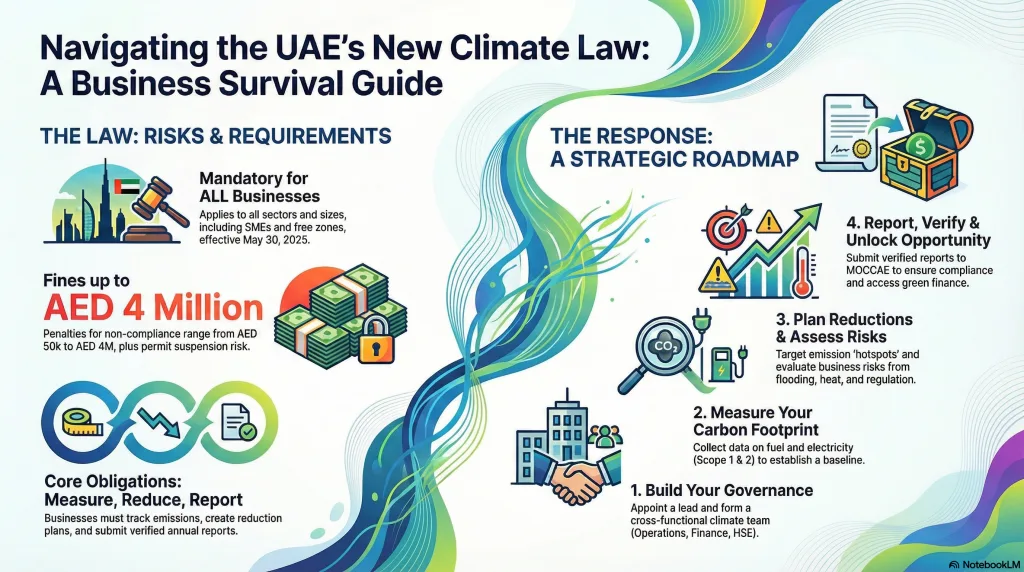
Or you can have a look at this infographic that demonstrates the key facts and figures from the post:
You can also watch this explainer YouTube Video that gives a quick overview of the post:
Introduction
The UAE has officially entered a new era of climate accountability. With the issuance of Federal Decree-Law No. (11) of 2024 on the Reduction of Climate Change Effects on 28 August 2024, the country transformed climate action from voluntary corporate aspiration into legal obligation. The law came into force on 30 May 2025, creating a binding framework that requires all businesses operating in the UAE—including those in free zones—to measure, report, and reduce their greenhouse gas emissions.
This is not a distant policy announcement. It is a tangible, enforceable requirement that directly affects operational planning, financial reporting, and strategic decision-making for thousands of enterprises across the UAE economy. Companies that fail to comply face administrative fines ranging from AED 50,000 to AED 2,000,000, with penalties escalating to AED 4,000,000 for repeat or serious violations. Beyond financial penalties, non-compliance can result in permit suspension, supply chain exclusion, and reputational damage in an increasingly ESG-conscious market.
Yet this law also represents an opportunity. Businesses that move early to establish robust climate data systems, aligned with international frameworks like ISSB and GRI, position themselves for improved access to capital, stronger supplier relationships, and competitive advantage in a decarbonizing economy. The transition period—running until 30 May 2026—provides a practical window for preparation, but planning should begin immediately.
This blog post is a practical, step-by-step guide for UAE businesses navigating the new climate law landscape. It explains what the law requires, why it matters, which frameworks to use, and how to build the systems and processes needed for timely, credible compliance.
Definition: UAE Climate Law at a Glance
What It Is
Federal Decree-Law No. (11) of 2024 on the Reduction of Climate Change Effects is the UAE’s first federal-level, legally binding climate accountability framework. It covers all GHG-emitting entities across the public and private sectors, including those operating within free zones, and establishes mandatory obligations for emissions measurement, reporting, reduction, and participation in national climate mechanisms.
The law is part of the UAE’s broader commitment to achieving net-zero emissions by 2050 and fulfilling its obligations under the Paris Agreement. It aligns with the UAE Net Zero 2050 Strategic Initiative, the UAE Green Agenda 2030, and the UAE Vision 2030, positioning the country as a regional leader in climate governance.
Key Dates and Effective Timeline
| Milestone | Date | Implication |
|---|---|---|
| Law issued | 28 August 2024 | Federal Gazette publication; official enactment |
| Law effective | 30 May 2025 | Businesses must begin compliance operations |
| First registry window | By 28 June 2025 | Large emitters (≥0.5 MtCO₂e) register with National Carbon Credit Registry |
| Full compliance deadline | 30 May 2026 | All reporting, reduction plans, and systems must be operational |
Your business has approximately 12 months from 30 May 2025 to establish measurement systems, conduct emissions calculations, develop reduction strategies, and submit verified reports to the Ministry of Climate Change and Environment (MOCCAE) or competent authorities in your emirate.
Who Is Covered
The law applies to:
- All private sector entities in the UAE of any size and sector
- Free zone entities (JAFZA, DMCC, RAKEZ, etc.)—no exemption
- State-owned enterprises and public sector bodies
- Sectoral focus (early implementation): energy, infrastructure, manufacturing, real estate, logistics, aviation, hospitality, financial services
The law does not exempt SMEs, nor does it provide sector-based grace periods beyond the general 12-month transition. However, implementation is phased via Cabinet Resolutions and MOCCAE guidance. Entities with combined Scope 1 and Scope 2 emissions exceeding 0.5 million metric tonnes CO₂-equivalent (MtCO₂e) annually face mandatory reporting from day one. Others may be phased in or face lighter initial obligations, but regulatory guidance is still evolving.
Core Obligations for Businesses
Under Article 6 of the law, designated “sources” must:
- Measure emissions regularly across Scope 1 (direct) and Scope 2 (indirect electricity) at minimum, using methodologies and standards set by MOCCAE (aligned with GHG Protocol and ISO 14064).
- Prepare and maintain a GHG emissions inventory covering all identified sources, with complete documentation of calculation assumptions, emission factors, and data traceability.
- Submit periodic annual reports to MOCCAE or competent authorities using prescribed electronic systems and standard formats, beginning with the first full reporting year after 30 May 2025.
- Conduct third-party verification of reported emissions by accredited verifiers before submission, ensuring independent validation of data and methodologies.
- Develop and implement emissions reduction measures addressing both direct emissions (Scope 1) and indirect energy emissions (Scope 2), with achievable targets and timelines aligned to national sector pathways.
- Maintain complete records for at least five years, enabling regulatory audits, verifications, and historical trend analysis.
- Assess and disclose climate-related risks, including physical risks (flooding, heat, water scarcity) and transition risks (regulatory changes, technology shifts, market evolution).
Penalties and Enforcement
Non-compliance is taken seriously. The law establishes a tiered penalty framework:
- Initial violation: AED 50,000 to AED 2,000,000 for failure to measure, report, maintain records, or conduct risk assessments.
- Repeat violations: Penalties can be doubled if the same violation occurs within two years of a prior conviction.
- Serious or persistent non-compliance: Fines can escalate up to AED 4,000,000, with additional administrative measures including permit suspension, activity restrictions, and potential debarment from government procurement.
Enforcement is overseen by MOCCAE in coordination with competent authorities in each emirate and free zone. Given the high-profile nature of the law and the UAE’s climate commitments, enforcement is expected to be consistent and transparent.
Regulatory Governance
MOCCAE (Ministry of Climate Change & Environment) is the primary authority responsible for:
- Setting and updating reporting standards aligned with GHG Protocol and ISO 14064
- Establishing annual sector-specific emissions reduction targets
- Operating the National Carbon Credit Registry (Cabinet Resolution 67/2024)
- Issuing guidance and implementing regulations
- Overseeing compliance and enforcement
Competent authorities in each emirate and free zone (e.g., DED in Dubai, Abu Dhabi Department of Economic Development, free zone authorities) are responsible for:
- Local implementation and awareness
- Coordination with sector-specific regulators
- Permitting and licensing enforcement
Sector regulators including the Securities and Commodities Authority (SCA), Central Bank of UAE (CBUAE), Dubai Financial Market (DFM), and Abu Dhabi Securities Exchange (ADX) are aligning climate disclosure expectations with the law.
Background and History: Why the UAE Adopted This Law
UAE’s Climate Context and Challenges
The UAE’s climate is characterized by extreme heat, high humidity in coastal areas, and historically low rainfall (typically under 100 mm annually). Over recent decades, rapid urbanization and critical infrastructure development have increased exposure of people, assets, and businesses to climate hazards including flash floods, dust storms, extreme heatwaves, and water scarcity. Climate change is amplifying these risks.
Temperature trends: Scientific observations show rising average temperatures across the Arabian Peninsula, with more frequent and intense heatwaves affecting outdoor work productivity, electricity demand for cooling, and water availability.
Extreme rainfall and flooding: While the UAE remains arid, atmospheric conditions driven by climate change have made heavy, intense rainfall events more likely. These rare but destructive events overwhelm drainage systems and cause significant infrastructure and economic damage.
The April 2024 Floods: The Catalyst
On 16-17 April 2024, the UAE experienced its heaviest rainfall in more than 75 years. Parts of Dubai and other emirates received between 50 and 200 millimeters of rain in 24 hours, causing severe flooding, airport disruption, and infrastructure damage. The event resulted in significant economic losses, business continuity challenges, and loss of life.
Rapid climate attribution analyses, published in peer-reviewed journals including Nature Communications Earth & Environment, found that human-driven climate change significantly increased the likelihood and intensity of the April 2024 storm. The unusual synoptic atmospheric pattern, elevated sea surface temperatures in the Arabian Sea, and a moister atmosphere—conditions made more probable by warming—combined to produce record rainfall.
For the private sector, the 2024 floods crystallized climate risk as a tangible, near-term operational threat, not a distant future concern. Logistics companies faced port and warehouse disruptions. Real estate developers and property owners assessed flood vulnerability in their portfolios. Hospitality and retail saw business interruption. Finance institutions recognized climate as a credit and operational risk.
Scientific Context: Changing Climate Patterns
Regional hydrometeorological research has identified worrying trends:
- Heavy precipitation events in the Arabian Peninsula are becoming more frequent and intense, with studies documenting the increasing probability of multi-day rainfall episodes that overwhelm local drainage capacity.
- Heat stress is intensifying, with compound risks of simultaneous extreme heat and humidity affecting worker productivity, especially in outdoor and logistics-intensive sectors.
- Water scarcity is exacerbating as higher temperatures increase evaporation and alter precipitation patterns, affecting freshwater availability for agriculture, industry, and municipal use.
Academic sources (cited at the end of this post) support the conclusion that climate change is not a future risk—it is reshaping the UAE’s operational environment now. Businesses must adapt their strategies, infrastructure, and risk management accordingly.
Policy Evolution Leading to the Law
The UAE’s path to Federal Decree-Law No. 11 of 2024 evolved over several years:
- 2022: The UAE became the first GCC nation to adopt a Net Zero by 2050 target and published its updated Nationally Determined Contributions (NDC) under the Paris Agreement.
- 2023: The UAE designated 2023 as the “Year of Sustainability” and hosted COP28 in Dubai, reinforcing international climate leadership and signaling domestic action.
- 2024: Against the backdrop of April’s catastrophic floods and global climate momentum, the UAE enacted Federal Decree-Law No. 11 of 2024, moving from voluntary corporate sustainability to binding legal accountability.
The law consolidates earlier climate, energy efficiency, and sustainability policies into one integrated framework, backed by enforcement mechanisms and aligned with international standards (GHG Protocol, ISO 14064, ISSB, GRI).
GHG Emission Measurement and Reduction: Why It Matters
The Foundation: Why Measurement Is Critical
GHG measurement is the foundation upon which all climate action rests. Without accurate, auditable data on emissions sources, quantities, and trends, neither businesses nor regulators can:
- Design realistic decarbonization targets
- Track progress towards climate goals
- Identify cost-reduction opportunities through energy and process efficiency
- Communicate credibly with investors, lenders, customers, and regulators
- Participate in carbon markets or offsetting schemes
Article 6 of the UAE Climate Law anchors the entire framework on measurement and reporting. If your business cannot demonstrate a defensible, complete, and verified GHG inventory, you cannot comply with the law, access green financing, satisfy large customers, or participate in the national carbon credit system.
How Measurement and Reduction Support Climate Goals
At the national level, high-quality emissions data allows MOCCAE and sector regulators to:
- Set evidence-based annual emissions reduction targets for each sector
- Monitor progress towards the UAE Net Zero 2050 goal
- Design policy interventions (standards, incentives, carbon pricing) with confidence
- Report to the UNFCCC and demonstrate Paris Agreement compliance
At the company level, a rigorous GHG inventory enables:
- Identification of hotspots: Which activities drive the largest emissions? (e.g., grid electricity, fleet fuel, refrigerant leakage, purchased goods and services?)
- Prioritization of reduction levers: Where can your business achieve the fastest, lowest-cost emissions cuts? (e.g., LED lighting retrofits, HVAC optimization, renewable energy procurement, fleet electrification, waste reduction?)
- Target setting: What are realistic, science-aligned reduction pathways for your business over 5, 10, and 30 years?
- Resilience and cost management: Many emissions reduction measures—energy efficiency, distributed renewables, local sourcing, waste minimization—also improve operational resilience and reduce costs, especially in the face of extreme weather, grid disruptions, and supply chain volatility.
Business Imperatives for Measurement and Reduction
For UAE companies, GHG measurement and reduction are no longer “nice-to-have” ESG initiatives. They are now critical for:
1. Regulatory Compliance and Avoiding Penalties
Failure to measure, report, or maintain records under the climate law can trigger fines up to AED 2 million for first violations, rising to AED 4 million for repeat breaches. Beyond financial penalties, regulatory non-compliance can result in permit suspension, exclusion from government tenders, and reputational damage that affects market access and stakeholder trust.
2. Access to Finance and Capital
Local and international financial institutions are increasingly integrating climate risk and ESG data into credit decisions. Banks such as Emirates NBD, FAB, and others are pricing loans based on climate performance and offering sustainability-linked financing facilities. Investors and development finance institutions (including green bond markets) require climate disclosures aligned with ISSB and GRI to inform capital allocation. Robust GHG data and credible reduction targets are now table-stakes for competitive lending and investment terms.
3. Supply Chain and Value Chain Positioning
Large UAE companies—including ADNOC, DP World, Emirates, Emaar, and major hospitality groups—are strengthening their own climate commitments and increasingly requesting climate data and reduction plans from suppliers. As these companies set scope-wide emissions targets, they will cascade requirements down their value chains. SMEs and mid-cap suppliers without credible GHG accounting will find themselves at competitive disadvantage, facing exclusion from contracts with major customers or pressure to rapidly improve their climate performance.
4. Cost Management and Operational Efficiency
Energy and fuel represent significant operational costs in the UAE, particularly in energy-intensive sectors. Systematic GHG measurement often uncovers inefficiencies—unoptimized HVAC, aging equipment, process waste—that drive both emissions and unnecessary costs. Emissions reduction investments (efficiency retrofits, renewable energy, process optimization) frequently deliver paybacks within 3-7 years while improving resilience to grid constraints and fuel price volatility.
5. Market and Competitive Advantage
As sustainability and climate performance become defining competitive factors—for employees, customers, investors, and communities—early-moving companies that demonstrate credible climate action and transparent reporting build brand value, attract talent, and position themselves as industry leaders. This is particularly pronounced in sectors like hospitality, retail, and professional services, where customer expectations around sustainability are rising.
Scope 1, Scope 2, and (Eventually) Scope 3
To meet the law and align with international standards, your business must understand the three scopes of emissions:
| Scope | Definition | Examples | Immediate Obligation? |
|---|---|---|---|
| Scope 1 (Direct) | GHG emitted from sources owned or controlled by your company | Fuel combustion in company vehicles, on-site generators, boilers, refrigerant leaks, process emissions | Yes, mandatory |
| Scope 2 (Indirect Energy) | GHG emitted from electricity, heating, cooling, or steam purchased and consumed by your company | Grid electricity, district cooling, purchased steam | Yes, mandatory |
| Scope 3 (Value Chain) | All other upstream and downstream emissions in your value chain | Purchased goods and services, business travel, employee commuting, waste disposal, logistics, use of sold products, investments | Eventually required; phase-in expected |
The UAE Climate Law initially focuses on Scope 1 and 2. However, international frameworks like ISSB and GRI, as well as investor and lender expectations, increasingly demand Scope 3 disclosure (particularly Scope 3 Category 15: Investments, for financial institutions, and Categories 1, 4, 9, for most other businesses). Your business should plan to measure and reduce Scope 3 emissions over the next 3-5 years.
Best Practices from UAE: Leading Companies and Their Climate Reporting
Several leading UAE companies already publish advanced climate and sustainability disclosures aligned with global frameworks such as GRI, TCFD, and emerging ISSB standards. Their practices provide valuable reference points for businesses preparing for the new law.
Banking Sector: Emirates NBD Group
Emirates NBD Group, the UAE’s largest banking group by assets, is a frontrunner in climate reporting and sustainable finance.
Standards and frameworks used:
- GRI: Full alignment with GRI 2021 Universal Standards, including GRI 302 (Energy), GRI 305 (Emissions), and GRI 303 (Water)
- TCFD: Publishes inaugural TCFD report (2024) covering governance, strategy, risk management, and metrics and targets
- ISSB: Preparing first IFRS S1 and S2 (ISSB) report for 2025 release with third-party assurance
- TNFD: First MENAT bank to become TNFD (Task Force on Nature-related Financial Disclosures) early adopter (disclosure in 2025)
- Additional: CDP reporting, PCAF signatory (financed emissions), UN Principles for Responsible Banking, SASB metrics
Key climate KPIs disclosed (2024):
- Scope 1: ~970 tCO₂e (operational emissions from offices, vehicles)
- Scope 2: ~23,216 tCO₂e (purchased electricity, cooling)
- Scope 3: ~353,585 tCO₂e (business travel, financed emissions via PCAF methodology)
- Financed emissions: Tracked separately per PCAF to assess emissions in loan and investment portfolios
- Intensity: 0.0008 kg CO₂e per AED of revenue
- Water efficiency: 5% annual reduction target
- Renewable energy: Growing share of electricity from renewables; 35 LEED-certified branches (16 Platinum, 19 Gold)
Progress and achievements:
- Scope 2 emissions reduced 20% in 2023 vs. 2022 through energy efficiency and renewable procurement
- Launched USD 750 million green bond (largest ever by a bank in MENAT region)
- Introduced ESG-linked working capital facility and sustainable fixed deposit for retail customers
- Signed UN Principles for Responsible Banking and UAE Climate-Responsible Companies Pledge
- Target: USD 30 billion sustainable financing by 2030; net zero pathway by 2025
Construction and Real Estate: Emaar Properties
Emaar, one of the UAE’s largest real estate and hospitality developers, integrates climate considerations across its portfolio.
Standards and frameworks:
- GRI Standards (energy, emissions, water, waste topics)
- TCFD-aligned climate risk narrative addressing physical and transition risks
Climate KPIs:
- Energy and GHG emissions intensity per square meter of property
- Emissions per guest night or available room (hospitality operations)
- Share of portfolio with green certifications (LEED, Estidama, Pearl Rating)
- Water and waste metrics per unit of operation
Progress:
- Increasing proportion of new and renovated buildings meeting high energy performance standards
- Multi-year downward trend in energy intensity through efficient HVAC, lighting, and envelope upgrades
- Integration of onsite solar and green infrastructure in flagship projects
Oil and Gas: ADNOC (Abu Dhabi National Oil Company)
ADNOC, a regional leader in hydrocarbon production, has published increasingly detailed climate disclosures.
Standards and frameworks:
- GRI framework adapted for oil and gas operations
- TCFD recommendations for climate risk disclosure
- Oil and Gas Methane Partnership (OGMP) or similar methane standards
Climate KPIs:
- Scope 1 and Scope 2 emissions in tonnes CO₂-equivalent
- Methane intensity (methane/total hydrocarbon production)
- Flaring volumes and emissions
- Emissions intensity per barrel of oil equivalent
- Carbon capture, utilization, and storage (CCUS) capacity and volumes
- Share of operational power from clean and nuclear energy
Progress and targets:
- Net Zero target by 2045
- Methane reduction milestones and initiatives
- Deployment of large-scale CCS/CCUS projects to reduce direct emissions
- Transition of operational power to nuclear and solar energy
- Reduction in emissions intensity per barrel over multi-year periods
Logistics: DP World
DP World, headquartered in Dubai and operating major ports and logistics hubs globally, maintains detailed climate reporting.
Standards and frameworks:
- GRI indicators customized for port and logistics operations
- TCFD-aligned disclosure of physical and transition climate risks
Climate KPIs:
- Scope 1 and Scope 2 emissions from terminals, equipment, and facilities
- Emissions intensity per TEU (twenty-foot equivalent unit) handled or per tonne of cargo
- Share of equipment fleet that is electrified or hybrid
- Renewable energy percentage (onsite solar, grid renewable tariffs)
- Water and waste metrics
Progress:
- Rollout of electrified quay cranes and yard equipment at major terminals
- Installation of rooftop solar and battery storage at multiple facilities
- Deployment of shore power infrastructure to reduce emissions from vessel fuel consumption at berth
- Multi-year downward trend in emissions intensity and concrete medium-term decarbonization roadmap
Airlines: Emirates Airline
Emirates Airline provides environmental and sustainability disclosures focused on fuel efficiency and fleet modernization.
Standards and frameworks:
- Aviation-specific emissions metrics aligned with international aviation reporting standards
- GRI-aligned energy and emissions disclosures
Climate KPIs:
- CO₂ emissions per passenger-kilometer (passenger efficiency)
- CO₂ emissions per freight tonne-kilometer (cargo efficiency)
- Total fuel burn and jet fuel consumption trends
- Average fleet age and modernization rate
- Sustainable aviation fuel (SAF) consumption and plans
Progress:
- Continuous fleet renewal towards newer, more fuel-efficient aircraft models
- Operational efficiency improvements including route optimization, weight reduction, and air traffic coordination
- Pilot programs and partnerships to source and trial sustainable aviation fuels (SAF)
- Participation in international initiatives to scale low-carbon aviation
Hospitality: FIVE Holdings
FIVE Holdings, operator of FIVE Hotels and Resorts, emphasizes sustainability and circular economy principles across its properties.
Standards and frameworks:
- GRI metrics for energy, emissions, water, and waste across hospitality operations
- Alignment with sector benchmarks and ESG ratings (e.g., Hospitality ESG scorecard)
Climate KPIs:
- Energy consumption and GHG emissions per available room per night
- Per guest night metrics for water, waste, and other environmental indicators
- Share of electricity from renewable sources
- Waste diversion rate and circular economy initiative impact
Progress:
- Implementation of high-efficiency HVAC, LED lighting, and building management systems
- Onsite rooftop solar installations at multiple properties
- Circular initiatives such as food waste-to-compost, waste-to-revenue projects, and supply chain optimization
- Year-on-year improvement in energy and emissions intensity with transparent reporting
Step-by-Step Guide for Climate Reporting Under UAE Climate Law
The following is a practical, operational guide for building and implementing a climate reporting system compliant with the UAE Climate Law, aligned with ISSB and GRI frameworks, and positioned for competitive advantage in a climate-conscious market.
Step 1: Clarify Your Regulatory Exposure
Objective: Determine whether your business is a designated “source” under the law and understand your obligation timeline.
Actions your sustainability team should take:
- Identify your sector: Does your industry fall within early-implementation priorities? (Energy, heavy industry, construction, logistics, aviation, hospitality, financial services, large manufacturing are typical early targets; others will be phased in.)
- Estimate annual emissions: Calculate or estimate your combined Scope 1 and Scope 2 emissions in tonnes CO₂-equivalent. If annual emissions exceed 0.5 MtCO₂e (500,000 tCO₂e), you have mandatory reporting obligations from day one. If below this threshold, you may face lighter initial requirements, but guidance is still evolving, so prepare for mandatory compliance regardless.
- Check your footprint: Large facilities (manufacturing plants, data centers, large real estate portfolios), significant vehicle fleets, high energy consumption, or process emissions suggest you may be material and subject to obligations.
- Engage your free zone authority (if applicable): If your business operates in a free zone (JAFZA, DMCC, RAKEZ, etc.), contact the zone authority for clarification on local implementation timelines and sector-specific requirements.
- Monitor MOCCAE guidance: Regularly check the MOCCAE website (moccae.gov.ae) and official government legislation portals (uaelegislation.gov.ae) for Cabinet Resolutions, ministerial decisions, and sector-specific reporting standards and thresholds.
Deliverable: A brief internal memo documenting your sector classification, estimated emissions scale, and obligation status.
Step 2: Build Your Internal Climate Governance Structure
Objective: Establish clear ownership, roles, and accountability for climate data, reporting, and emissions reduction.
Actions:
- Designate a climate reporting lead: Appoint a senior individual (often from HSE, operations, finance, or sustainability) with executive support and a clear mandate to coordinate climate compliance across the organization. This person should have authority to request data from all business units and decision-making input on strategy.
- Form a cross-functional working group: Convene representatives from:
- Operations/Facilities: Provides data on fuel, electricity, equipment, and process emissions
- Finance: Links climate data to financial planning, sustainability-linked finance, and cost management
- Procurement: Manages supplier climate data collection and supply chain emissions (Scope 3)
- HSE/Quality: Integrates climate into risk management and internal audit
- IT/Data Management: Maintains systems, data security, and long-term record retention
- Define roles and responsibilities: Clearly document who collects data, who validates it, who calculates emissions, and who approves reports before submission.
- Establish governance oversight: Link climate reporting and emissions reduction targets to senior management and board-level oversight (e.g., board ESG committee, executive compensation scorecards).
- Allocate resources: Budget for external expertise (verifiers, consultants), software systems, training, and staff time. Early investment in systems prevents costly rework.
Deliverable: Governance charter, role definitions, and organizational structure document.
Step 3: Map Your Operations and Emission Sources
Objective: Create a comprehensive inventory of all facilities, activities, and potential emission sources across your business.
Actions:
- List all sites and operations: Compile a complete inventory of every location where your business operates: offices, warehouses, manufacturing plants, hotels, branches, distribution centers, data centers, etc. Include leased and owned facilities.
- Identify Scope 1 sources:
- Fuel combustion: generators, boilers, process heaters, kilns, furnaces (record fuel type, consumption)
- Company-owned vehicle fleet: cars, trucks, vans (record fuel type, annual consumption)
- Fugitive emissions: refrigerant leaks (air conditioning, refrigeration), insulating gases in electrical equipment, process losses
- Industrial processes: chemical production, cement, steel, food processing (process-specific emissions)
- Identify Scope 2 sources:
- Grid electricity purchased from utilities (all sites)
- District cooling (in Dubai and Abu Dhabi, buildings often use district cooling rather than on-site chillers)
- District heating (less common in UAE, but relevant for some facilities)
- Identify likely Scope 3 sources (preliminary; deep analysis comes later):
- Purchased goods and services (raw materials, packaging, supplies)
- Business travel (flights, hotels)
- Employee commuting
- Waste disposal
- Logistics and transportation (outsourced, non-fleet)
- Investments and financed emissions (for banks and investors)
- Use and end-of-life of sold products (for manufacturers and retailers)
- Prioritize: Rank sources by estimated materiality (largest emitters first). This focuses your initial effort on data that matters most.
Deliverable: Site inventory spreadsheet and source mapping document, organized by scope and facility.
Step 4: Design and Implement Simple Data Collection Systems
Objective: Establish systematic, auditable processes to capture, store, and validate GHG-relevant data.
Actions:
- Create a standard GHG data template: Design a spreadsheet or digital form with fields for:
- Facility name and location
- Emission source (e.g., “Boiler – Natural Gas,” “Fleet – Diesel Trucks,” “Grid Electricity”)
- Activity unit (e.g., liters, kWh, metric tonnes)
- Activity data (quantity consumed, monthly or annual)
- Reporting period (month, quarter, year)
- Data source (utility bill, fuel delivery receipt, maintenance log, subcontractor report)
- Data owner (responsible person)
- Quality flag (estimated, measured, verified)
- Supporting document reference
- Organize data collection processes:
- Electricity: Request monthly and annual consumption from utility companies (DEWA, EWEC, etc.) or read meters directly; maintain invoices for 5 years
- Fuel (fleet and on-site): Track fuel card transactions, fuel delivery receipts, and internal fuel dispensing logs
- Refrigerants and process gases: Maintain equipment maintenance logs noting gas refills, top-ups, and leakage incidents
- Waste: Obtain reports from waste management vendors on waste volumes by category
- Implement data management discipline:
- Assign responsibility for each data stream
- Establish monthly or quarterly data validation meetings
- Build data traceability: every emissions figure must be traceable back to source documentation
- Version control: track changes and maintain audit trail
- Digitize where practical:
- Use ERP or CMMS (computerized maintenance management system) integration where available
- Consider simple cloud-based sustainability tools or Excel templates with built-in controls
- Plan for API integration with utility portals (many utilities now offer direct data feeds)
- Ensure 5-year retention: Establish a secure document repository (cloud storage, archive) where all supporting evidence is stored and retrievable for audits.
Deliverable: Data management procedure document, templates, and initial 12 months of baseline data.
Step 5: Calculate GHG Emissions Using Recognized Standards
Objective: Convert activity data into standardized CO₂-equivalent emissions using methodologies approved under UAE regulations.
Actions:
- Use recognized methodologies:
- GHG Protocol Corporate Standard: The international standard upon which most reporting is based
- ISO 14064: International standard for quantification and reporting of GHG
- MOCCAE guidance: As detailed in implementation regulations (e.g., UAE-specific emission factors for electricity)
- Apply UAE-specific emission factors:
- Grid electricity: Use UAE/emirate-specific grid emission factors (e.g., kg CO₂e per kWh). The UAE electricity grid mix includes natural gas, nuclear (Barakah), and growing renewables; factors vary by emirate and should be updated annually.
- Fuels: Use standard international factors for diesel, gasoline, natural gas, liquefied petroleum gas (LPG), etc., unless UAE-specific factors are published
- Refrigerants: Use global warming potential (GWP) factors per IPCC guidelines
- Calculation workflow:
- Activity data × Emission factor = GHG emissions (tCO₂e)
- Example: 1,000,000 kWh (electricity) × 0.5 kg CO₂e/kWh = 500,000 kg = 500 tCO₂e (Scope 2)
- Handle data gaps conservatively:
- If data is missing, estimate conservatively (assume higher consumption) rather than zero
- Document the gap and develop a plan to collect actual data in the next reporting period
- Transparently disclose estimation methods and gaps in your reports
- Calculate intensity metrics:
- Scope 1 and 2 per unit of revenue (kg CO₂e per AED)
- Scope 1 and 2 per employee (tCO₂e per person)
- Scope 2 per square meter of facility (kg CO₂e/m²)
- Scope 1 per vehicle or per million vehicle-kilometers (for fleets)
- These intensity metrics allow comparison over time and across peers
Deliverable: Emissions calculation spreadsheet with full documentation of factors, assumptions, and source data.
Step 6: Align Disclosures with GRI and ISSB Frameworks
Objective: Structure climate reporting to meet both UAE regulatory expectations and international investor/stakeholder standards.
Actions:
- Use GRI 302 (Energy) and GRI 305 (Emissions) as your core environmental disclosure framework:
- GRI 302: Report total energy consumption by type (electricity, natural gas, liquid fuels), intensity metrics, and energy reduction targets
- GRI 305: Report Scope 1, Scope 2, and Scope 3 emissions separately, intensity metrics, and percentage reduction achieved
- Layer ISSB / IFRS S2 narrative on top for governance and strategy:
- Governance: Who on the board/management oversees climate? How is climate integrated into strategy and risk management?
- Strategy: How does climate change affect your business model and financial performance? What are your opportunities and risks?
- Risk Management: What processes identify and manage climate risks? How is scenario analysis conducted?
- Metrics and Targets: What are your short- and long-term emissions reduction targets? How do you track progress?
- Practical integration: For SMEs, this might look like:
- Executive summary: 1-2 page climate overview (governance, strategy, key risks)
- GRI-style data tables: Energy and emissions by facility/source, intensity, year-on-year comparison
- Reduction plan narrative: Concrete measures (e.g., LED retrofit, solar installation, fleet electrification), expected impact, timeline
- Risk assessment: 1-2 page summary of physical (floods, heat) and transition (regulatory, market) risks to the business
- Ensure consistency across reports: Climate data should reconcile with:
- Annual corporate social responsibility (CSR) reports
- Financial reports (energy costs linked to emissions, carbon finance integrated into capital planning)
- Investor presentations and sustainability communications
Deliverable: Climate reporting template aligned to GRI 302/305 and ISSB structure; draft climate narrative.
Step 7: Design Your Emissions Reduction Plan
Objective: Translate regulatory mitigation requirements into concrete, measurable, financial-grounded actions.
Actions:
- Analyze emissions hotspots: Using the calculated inventory, identify which sources drive 80% of emissions. Focus reduction efforts there first.
- Map available mitigation measures per the law’s Article 4, which lists:
- Energy efficiency improvements (HVAC, lighting, insulation, equipment)
- Clean energy adoption (rooftop solar, grid renewable tariffs, on-site generation)
- Process improvements (waste reduction, material efficiency, alternative processes)
- Fluorocarbon management (refrigerant leakage prevention, alternative refrigerants)
- Carbon capture, utilization, and storage (CCUS)
- Waste management and circular economy (waste-to-energy, recycling, composting)
- Carbon offsetting (participation in carbon markets, investment in offsets—use cautiously and after reducing direct emissions)
- Prioritize by cost-effectiveness and co-benefits:
- LED and HVAC retrofits: typically 3-7 year payback, operational cost savings
- Solar: 8-12 year payback, energy independence, hedge against rising electricity costs
- Fleet electrification: longer payback (10+ years) but declining battery costs, operational savings, regulatory necessity
- Waste reduction: often low-cost, operational efficiency gains
- Set realistic targets:
- Short-term (1-3 years): 10-20% reduction from baseline year
- Medium-term (5-10 years): 30-50% reduction
- Long-term (2030-2050): alignment with national net-zero pathway
- Assign ownership and accountability: Each reduction initiative should have a responsible manager with authority and budget.
- Establish measurement and verification plan: How will you confirm that reduction measures actually delivered the expected emissions savings? (e.g., pre/post retrofit energy monitoring, before/after utility bills, equipment efficiency data)
Deliverable: Emissions reduction roadmap (1-2 pages) with specific measures, timelines, budgets, expected impact, and responsible owners.
Step 8: Integrate Climate Risk and Adaptation
Objective: Address the flip side of climate action: understanding and managing climate-related risks to the business.
Actions:
- Identify physical climate risks relevant to your operations:
- Flooding: Does your facility sit in a flood-prone area? (Use Dubai Municipality and Emirate flood maps)
- Heat stress: Does your operation employ outdoor workers or rely on air cooling?
- Water scarcity: Is your business water-intensive (cooling, manufacturing, hospitality)?
- Supply chain disruption: Are your suppliers or logistics partners vulnerable to climate hazards?
- Assess transition risks:
- Regulatory: How might tightening climate regulations (carbon pricing, building codes, transport standards) affect your costs?
- Technology: How might low-carbon alternatives disrupt your market? (e.g., electrified transport replacing fossil fuel logistics)
- Market: Are your customers, lenders, or investors demanding climate action? Could climate performance affect market share?
- Develop adaptation measures:
- Flood resilience: upgrade drainage, install pump systems, relocate sensitive equipment
- Heat adaptation: enhanced cooling, outdoor worker protection, operational scheduling
- Supply chain diversification: identify alternative suppliers less vulnerable to climate shocks
- Financial planning: model climate scenarios (e.g., carbon price, energy cost escalation) in capital budgeting
- Integrate into TCFD/ISSB narrative: Describe the top 2-3 climate risks facing your business and your adaptation strategy.
Deliverable: 1-2 page climate risk assessment and adaptation plan.
Step 9: Prepare Formal Reports for MOCCAE Submission
Objective: Package your GHG data, reduction strategy, and risk assessment into the format required by regulators.
Actions:
- Monitor MOCCAE reporting requirements: As the ministry issues detailed regulations and e-submission forms, align your data structure to match. Key elements expected:
- Annual GHG emissions inventory (Scope 1, 2) by source
- Reduction measures implemented and planned
- Expected impact of reduction measures
- Climate risk assessment
- Governance and oversight structures
- Prepare supporting documentation:
- Data calculation sheets showing activity data, emission factors, and results
- Copies of utility bills and meter readings
- Maintenance logs and equipment records
- Third-party verification letter (once you engage a verifier)
- Use electronic submission systems: MOCCAE is building an electronic portal for submission. Prepare data in formats compatible with the portal (likely CSV, Excel, or web form).
- Coordinate with verifier: Before final submission, engage a MOCCAE-accredited third-party verifier to audit your data, methodologies, and internal controls.
Deliverable: Complete submission package, electronically formatted, with supporting documentation and verifier letter.
Step 10: Obtain Management Sign-Off and Board Approval
Objective: Ensure senior leadership and governance bodies are engaged and accountable for climate compliance and strategy.
Actions:
- Present to senior management and board:
- Summary of current emissions baseline
- Climate risks identified
- Reduction strategy and financial implications
- Governance and oversight plan
- Regulatory timeline and compliance status
- Gain approval for:
- Emissions reduction targets and investment plans
- Public disclosure and reporting approach
- Resource allocation (budget, staff, systems)
- Governance structures and escalation paths
- Link to executive incentives: Align executive compensation (bonuses, stock awards) to ESG-linked KPIs, including emissions reduction and climate-related targets.
- Establish board-level oversight: Ensure climate is a regular board agenda item (at least quarterly), with updates on progress, risks, and strategic decisions.
Deliverable: Board approval memo, updated ESG committee charter integrating climate, executive scorecards with climate KPIs.
Step 11: Plan for Verification, Assurance, and Continuous Improvement
Objective: Ensure credibility, compliance, and ongoing improvement of climate reporting systems.
Actions:
- Engage external verifiers:
- The UAE Climate Law requires third-party verification of reported emissions
- Identify MOCCAE-accredited verifiers (list to be published or available through MOCCAE)
- Define scope of verification: limited or reasonable assurance (limited = high-level check; reasonable = detailed audit)
- Agree on verification timeline to meet May 2026 deadline
- Prepare for assurance:
- Ensure internal controls and data governance are documented
- Conduct internal pre-audit to identify and correct gaps
- Provide verifier with complete data, supporting documents, and process descriptions
- Plan for incremental improvement:
- Year 1: Establish baseline; focus on Scope 1 and 2 completeness
- Year 2-3: Expand to material Scope 3 categories (e.g., business travel, logistics, purchased goods)
- Ongoing: Improve data granularity, close estimation gaps, adopt digital systems (IoT, automation)
- Benchmark against peers: Regularly compare your emissions intensity and reduction progress against industry peers (using ESG ratings, published reports) to identify improvement opportunities.
- Stay informed on evolving standards: ISSB, GRI, and TCFD continue to evolve. Plan to update your reporting framework every 2-3 years to maintain alignment with best practices.
Deliverable: Verification scope of work, multi-year continuous improvement roadmap.
UAE Climate Law: Minimum Viable Compliance for UAE SMEs
Many SMEs in the UAE—those with limited resources but significant emissions or exposure—must still comply with the climate law. The goal is to build a lean, cost-effective system that satisfies regulators and key customers without overwhelming the organization.
Lean System Design
Core personnel and governance:
- One dedicated climate reporting coordinator (0.5 to 1.0 FTE) with management backing
- Simple steering committee of 3-4 people (operations, finance, HSE)
- Annual review by senior management
Data collection and calculation:
- Focus on your top 3-5 emissions sources (often electricity, main fleet fuel, on-site fuel)
- Simple Excel spreadsheet: monthly activity data (kWh, liters), annual totals, calculations
- Annual utility bills and fuel receipts kept for 5 years in a secure folder (digital or physical)
- Documented assumptions and emission factors (one-page method statement)
Emissions reduction:
- 3-5 concrete, low-cost measures: LED retrofits, thermostat optimization, preventive maintenance, driver training, small solar or green tariff pilot
- Realistic 2-3 year target: e.g., 15% reduction in electricity use per square meter through efficiency, or 10% reduction in fleet fuel per delivery through route optimization
- Written plan with responsible owners and budgets
Reporting and compliance:
- GRI-style summary: 1-2 page table of Scope 1 and 2 emissions, intensity, year-on-year trend, and reduction plan
- Use ISSB/TCFD high-level structure: 1-page governance summary (who oversees climate), 1-page risk assessment (top 2-3 risks), 1-page strategy/targets
- Submit to MOCCAE using their e-portal with internal sign-off and supporting documentation
Cost and Effort Estimate
For a typical SME with 100-500 employees and single or a few facilities:
| Item | Cost Estimate | Effort (person-hours) |
|---|---|---|
| Initial audit and system setup | AED 5,000-15,000 | 80-120 hours |
| Annual data collection and calculation | AED 2,000-5,000 | 40-60 hours |
| Third-party verification (external auditor) | AED 10,000-25,000 | – |
| Reporting and submission | Included above | 20-30 hours |
| Reduction investments (LED, solar pilot, etc.) | Highly variable; often has 3-7 year payback | – |
| Total Year 1 | AED 17,000-45,000 | 140-210 hours |
| Total Year 2+ | AED 12,000-30,000 | 60-90 hours |
Note: Costs and effort can be reduced if external expert support is minimized and systems are digitized. Many SMEs find that energy and fuel cost savings from reduction measures offset compliance costs within 2-3 years.
Phased Approach for Resource-Constrained SMEs
- Months 1-3: Collect 3-6 months of baseline data; estimate full-year emissions; draft simple inventory.
- Months 4-6: Finalize annual baseline; design reduction plan; set targets.
- Months 7-9: Implement quick-win reduction measures; prepare for third-party verification.
- Months 10-12: Engage verifier; finalize reports; submit to MOCCAE before 30 May 2026.
This phased approach is less resource-intensive and allows learning and adjustment as regulatory guidance clarifies.
Future Trends Affecting Climate Reporting in the UAE
The climate reporting landscape in the UAE will continue to evolve rapidly over the next 3-5 years. Businesses should be aware of key trends that will shape compliance requirements and opportunities.
Digitalization and Automation
What’s happening:
- MOCCAE is developing digital MRV (Measurement, Reporting, Verification) systems and e-submission portals to standardize data formats and enable real-time monitoring.
- Smart meters, IoT sensors, and building management systems are becoming more affordable, enabling automated capture of energy and emissions data.
- Companies are adopting dedicated ESG and carbon management software platforms that integrate with ERP systems, utility portals, and third-party data providers.
Implication for your business:
- Early adoption of digital systems now will reduce manual data collection burden and improve accuracy over time.
- Interoperability with MOCCAE systems is becoming a criterion for software selection.
- Plan to invest in data infrastructure: smart metering, API integrations, and cloud-based platforms are strategic.
AI and Advanced Analytics
What’s happening:
- AI-powered anomaly detection is improving to identify data errors, unusual consumption patterns, and efficiency opportunities.
- Machine learning models are being used to forecast emissions under different scenarios (business growth, climate impacts, technology adoption).
- Natural language generation tools are starting to assist in drafting climate narratives and scenario analyses.
Implication:
- Your business can leverage AI to improve data quality, identify hidden cost-reduction opportunities, and model climate scenarios for strategic planning.
- However, human judgment and expert review remain essential; AI is a tool, not a replacement for climate expertise.
Tokenization and Carbon Markets
What’s happening:
- The National Carbon Credit Registry (established under Cabinet Resolution 67/2024) will enable creation and trading of verified carbon credits.
- Digital platforms for carbon credit trading are under development, overseen by the Securities and Commodities Authority (SCA).
- Blockchain and tokenization technologies are being explored to enable transparent, efficient carbon credit trading.
Implication:
- Businesses that exceed their reduction targets can generate surplus carbon credits and trade them for revenue.
- Carbon credit markets will create new incentives for early movers in emissions reduction.
- However, carbon credits should not be relied upon as a substitute for direct emissions reductions; regulatory and market preference is for real, verified reductions.
Tightening Global Value Chain Requirements
What’s happening:
- International customers, supply chain partners, and financiers are increasingly requiring ESG and climate data from suppliers.
- Emerging regulations like the EU Carbon Border Adjustment Mechanism (CBAM) and corporate sustainability standards (e.g., CSRD in Europe) will raise baseline expectations for traded goods and services.
- Large UAE-based companies are embedding climate requirements into procurement and supply chain contracts.
Implication:
- Even if your business is not initially subject to direct UAE Climate Law obligations, customer or supply chain pressure may force early compliance.
- Building robust climate data systems now provides competitive advantage in value chains and access to premium markets.
Geopolitical and Regional Developments
What’s happening:
- GCC countries are increasingly coordinating on climate policy; Bahrain, Saudi Arabia, and Oman are considering or developing their own climate legislation.
- Regional consensus on carbon pricing, green finance standards, and ESG disclosure is emerging.
- International climate negotiations (post-COP29) continue to shape national climate targets and reporting standards.
Implication:
- UAE businesses operating across the GCC should prepare for multi-country climate compliance.
- Regional harmonization on standards and frameworks may reduce compliance complexity over time.
- Staying informed of GCC and international climate policy is strategic for multinational businesses.
Climate Change Impacts
What’s happening:
- Flooding, heat stress, and water scarcity continue to intensify in the UAE and region.
- Businesses are experiencing more frequent climate-related operational disruptions, property damage, and insurance cost increases.
- Investor and regulator scrutiny of climate risk management is deepening.
Implication:
- Physical climate risk to your assets and operations is real and measurable now, not a distant future concern.
- Climate risk management is becoming a core financial and operational risk, not an ESG side issue.
- Boards and senior management are expected to integrate climate risk into strategic planning and capital allocation.
UAE Climate Law: FAQ
1. What exactly is the UAE Climate Law and when does it apply to my business?
The UAE Climate Law is Federal Decree-Law No. (11) of 2024 on the Reduction of Climate Change Effects. It requires all businesses operating in the UAE (including those in free zones) to measure, report, and reduce their greenhouse gas emissions. The law became effective on 30 May 2025. If your business has combined Scope 1 and Scope 2 emissions exceeding 0.5 million tonnes CO₂-equivalent annually, you must report starting immediately. Smaller businesses may be phased in or face lighter initial obligations, but all businesses should prepare for mandatory compliance by 30 May 2026.
2. What are the penalties for not complying with the UAE Climate Law?
Non-compliance with the law can result in administrative fines ranging from AED 50,000 to AED 2,000,000 for first violations, with penalties potentially doubling (up to AED 4,000,000) for repeat or serious breaches. Beyond financial penalties, non-compliance may result in permit suspension, activity restrictions, and exclusion from government procurement. Early action to build compliant systems and credible reporting significantly reduces these risks.
3. What should my business do right now to start preparing for UAE Climate Law compliance?
Start immediately: (1) form a cross-functional climate team including operations, finance, HSE, and IT; (2) map your facilities and estimate annual Scope 1 and Scope 2 emissions; (3) collect at least 12 months of electricity and fuel data from utility bills and internal records; (4) decide whether to build climate systems in-house or engage external consultants; (5) monitor MOCCAE guidance and sector-specific standards as they are published; (6) plan your emissions reduction strategy with realistic targets. By beginning now, your business will have 12+ months to establish systems and processes before the May 2026 compliance deadline.
Free Download: Slide Deck of UAE Climate Law
You want to have all the important points discussed in the post as a beautfully designed PDF file? Click on the button below:
Conclusion
Federal Decree-Law No. (11) of 2024 on the Reduction of Climate Change Effects marks a watershed moment in the UAE’s climate governance and in business accountability across the country. The shift from voluntary, reputational sustainability initiatives to binding legal obligations—backed by substantial fines, enforcement, and oversight—is unprecedented in the GCC and a clear signal that climate action is now central to how the UAE does business.
For your business, the law creates both imperatives and opportunities. Compliance is non-negotiable: failing to measure, report, or reduce emissions can result in fines up to AED 4,000,000, permit suspension, and reputational damage in an interconnected business community. Yet early adoption of robust climate data systems, credible emissions reduction plans, and transparent reporting aligned with ISSB and GRI also unlocks competitive advantages: improved access to green finance, stronger positioning in supply chains of large companies, enhanced brand value, and operational cost savings through energy efficiency and process optimization.
The 12-month transition period (through 30 May 2026) is your window to build the necessary systems, close data gaps, and establish governance and accountability structures. Businesses that move now—beginning with honest assessment of their emissions, building cross-functional teams, implementing simple but auditable data collection, and designing credible reduction strategies—will be well-positioned to not only comply but to lead their sectors in climate performance and resilience.
The April 2024 floods demonstrated that climate change is not a future abstraction; it is reshaping business operations and risk profiles in the UAE today. Regulatory, financial, and market forces are converging to reward companies that take climate seriously. The time to act is now.
Academic and Scientific Sources (Background Section)
The climate and flooding context in this blog post is supported by peer-reviewed scientific research:
- Nature Communications Earth & Environment (2025): “From cause to consequence: examining the historic April 2024 rainstorm in the United Arab Emirates through the lens of climate change” – Rapid attribution analysis concluding that human-driven climate change significantly amplified the likelihood and intensity of the April 2024 storm.
- ScienceDirect (2023): “The rain deluge and flash floods of summer 2022 in the United Arab Emirates: Causes, analysis and perspectives on flood-risk reduction” – Hydrometeorological analysis of extreme precipitation and flash flood risk in the UAE context.
- Climate Analytics (2024): “Heavy precipitation hitting vulnerable communities in the UAE and Oman becoming an increasing concern” – Regional assessment of trends in extreme rainfall frequency and intensity.
- CNN Weather Analysis (2024): “Dubai’s deadly floods were made worse by climate change, scientists find” – Rapid climate attribution and impact analysis of April 2024 event.
- Regional Climate and Environmental Studies: Ongoing research on UAE heatwaves, sea surface temperature trends, and water scarcity related to climate change across the Arabian Peninsula.
These sources collectively support the scientific basis that climate change is already affecting UAE weather patterns, increasing the probability and intensity of extreme events, and making climate adaptation and mitigation urgent priorities for businesses and policymakers.
Sources
- UAE Federal Decree-Law No. 11 of 2024: https://uaelegislation.gov.ae/en/legislations/2558
- MOCCAE (Ministry of Climate Change & Environment): https://www.moccae.gov.ae/en/legislations
- PwC Middle East – UAE Climate Law: https://www.pwc.com/m1/en/services/assurance/manage-risk-in-business/uae-climate-change-law.html
- KPMG Lower Gulf – Understanding the UAE Climate Law: https://kpmg.com/ae/en/insights/esg/understanding-the-uae-climate-change-reduction-law.html
- EY – UAE Climate Transformation: https://www.ey.com/en_om/services/climate-change-sustainability-services/how-uae-is-transforming-the-climate-landscape-through-legislative-action
- PlanA – UAE Climate Law Academy: https://plana.earth/academy/uae-climate-law-what-you-need-to-know-about-the-new-regulation
- ISS Corporate – Local Business Implications: https://www.iss-corporate.com/resources/blog/navigating-the-uaes-new-climate-change-law-implications-for-local-businesses/
- Zevero – Practical Breakdown: https://www.zevero.earth/blog/uae-climate-law
- ESG Institute – Compliance and Readiness: https://www.the-esg-institute.org/blog/the-uae-climate-law-is-here-is-your-business-ready
- BDO – Announcement: https://www.bdo.ae/en-gb/news/news/announcing-the-federal-decree-law-no-(11)-of-2024-on-the-reduction-of-climate-change-effects
- Climate-Laws.org – UAE Policy Overview: https://climate-laws.org/geographies/united-arab-emirates
- GHG Protocol: https://ghgprotocol.org
- ISSB (IFRS Sustainability Standards): https://www.ifrs.org/groups/international-sustainability-standards-board/
- GRI (Global Reporting Initiative): https://www.globalreporting.org
- TCFD (Task Force on Climate-related Financial Disclosures): https://www.fsb-tcfd.org