
 By Admin
ESG Maturity Benchmarking: Insights from Saudi Arabia’s Giga Projects
ESG Maturity Benchmarking is a structured approach to assessing how advanced an organisation is in integrating ESG into governance, strategy, operations and reporting, rather than simply evaluating isolated initiatives or marketing claims. It examines the quality of disclosures, clarity of KPIs, target-setting discipline, accountability structures and data management practices, typically classifying organisations across defined maturity stages such as emerging, developing or advanced.
For Saudi giga projects, this is particularly relevant given their scale, public visibility and alignment with Vision 2030. These projects are not only building physical infrastructure, but also shaping the Kingdom’s global sustainability narrative. These flagship initiatives—Red Sea Global, Diriyah Company, NEOM, ROSHN Group, and Qiddiya Investment Company—are not merely construction endeavors but integrated ecosystems designed to deliver economic, social, and environmental value at scale. Collectively valued at over SAR 2 trillion, these projects are expected to generate millions of jobs, attract tens of millions of annual visitors, and contribute significantly to GDP growth. By early 2026, they have progressed from conceptual masterplans to active construction, early commissioning, and in some cases, operational phases, with sustainability embedded as a core operational principle from the outset.
A maturity-based benchmark enables leadership to understand how their ESG systems compare to peer giga projects, where disclosure gaps may exist, and how to strengthen reporting credibility in line with investor expectations, national sustainability commitments and evolving regulatory scrutiny. This blog post examines the ESG (Environmental, Social, Governance) strategies of these five projects, drawing exclusively from their publicly available sustainability and ESG reports (primarily 2023–2024 editions). It describes their core sustainability themes and operational status as of February 2026, followed by a ESG maturity benchmarking highlighting high-level focus areas for advancing ESG maturity. The analysis is descriptive and operational, offering prescriptive insights into next steps without normative judgment.
Key Takeaways from ESG Maturity Benchmarking
- ESG Maturity Benchmarking clarifies where each Saudi Giga Project stands today: A 30‑point ESG maturity scorecard (10 Environmental, 10 Social, 10 Governance) shows Red Sea Global and Diriyah in the Advanced range, NEOM and Qiddiya as Developing, and ROSHN as Emerging, based solely on publicly disclosed data.
- Saudi Giga Projects are strongest on strategy and governance frameworks, but uneven on quantified data: All five projects reference global frameworks (GRI, Vision 2030, PIF Green Finance), yet only Red Sea Global and Diriyah publish comprehensive baselines—for example, RSG discloses 133,080 tCO₂e Scope 1+2 emissions and Diriyah reports 411,541 tCO₂e across Scope 1–3.
- ESG Maturity Benchmarking highlights clear leaders in specific domains: Red Sea Global leads on regenerative tourism and external assurance (DNV‑assured sustainability report), Diriyah leads on KPI transparency and waste diversion (90.6% diversion, 27 ESG KPIs), NEOM and ROSHN lead on community beneficiaries, and Qiddiya stands out on worker welfare and accessibility (zero recruitment fees, ADA‑based design).
- The main improvement levers for Saudi Giga Projects are assurance, Scope 3 coverage, and KPI depth: The benchmarking study shows that advancing from “Developing” to “Advanced” maturity will require full Scope 3 inventories, limited external assurance on ESG data, and expansion of decision‑relevant KPIs—particularly for climate risk, supply chain emissions, and community impact.
- Using ESG Maturity Benchmarking as a management tool can unlock green finance and long‑term resilience: For Saudi Giga Projects, systematic benchmarking provides an objective basis for prioritising investments, preparing for ISSB/TCFD‑aligned disclosure, and strengthening eligibility for PIF‑linked green finance and future capital‑markets scrutiny.
You don’t have time to read through the blog post? No problem! We have a solution for you 🙂
You can have a look at this infographic that highlights the key parts of the post:
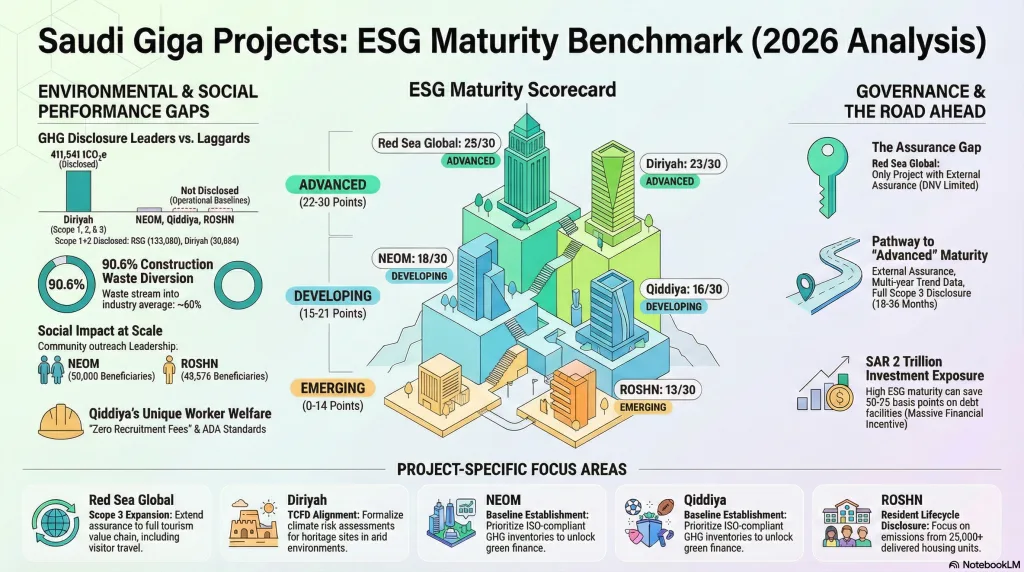
Alternatively, you can listen to this short sound clip that provides a capsule review of the post:
Finally, you can watch this explainer YouTube video that captures the core messages of the post:
Why ESG Maturity Benchmarking Matters to Saudi Giga Projects?
ESG maturity benchmarking serves as a critical operational tool for Saudi Arabia’s giga projects, providing structured insights into how sustainability strategies are translating from masterplan ambitions into measurable performance. As these developments transition from construction to early operations, benchmarking reveals not just current capabilities but also the operational readiness required for the following strategic imperatives:
- Green Finance Gateway. With collective investments exceeding SAR 2 trillion and PIF’s SAR 20B+ annual green financing pipeline, ESG maturity directly impacts access to green bonds and sustainability-linked loans. Projects demonstrating robust environmental baselines (GHG inventories, water stewardship), external assurance, and aligned KPIs unlock lower cost of capital—potentially saving 50-75 basis points on multi-billion SAR debt facilities. The PIF Green Finance Framework explicitly requires quantified ESG performance, positioning mature projects as preferred portfolio assets.
- Regulatory and Disclosure Convergence. Tadawul’s evolving ESG disclosure guidelines, ISSB S1/S2 adoption, and TCFD alignment create a unified reporting standard across PIF portfolio companies. Benchmarking identifies gaps in Scope 3 disclosure, climate risk assessment, and assurance levels, ensuring compliance as Saudi Arabia harmonizes with global norms. Early movers establish sector precedents, while laggards face investor scrutiny during IPO windows.
- Competitive Differentiation in Global Markets. As tourism, real estate, and lifestyle destinations compete for international capital and visitors, ESG maturity becomes a market signal. Red Sea Global’s DNV-assured regenerative model and Diriyah’s Mostadam Diamond certifications demonstrate how operational ESG excellence attracts institutional investors, premium operators, and high-value tourists. Benchmarking clarifies the path from “strategy declaration” to “performance verification,” essential for Vision 2030’s 150 million annual tourist target.
- Operational Risk Management at Giga Scale. Unlike traditional developments, giga projects face compounded risks across massive supply chains, phased commissioning, and long-term operations. Mature ESG frameworks enable predictive risk management—identifying Scope 3 hotspots, supply chain vulnerabilities, and climate adaptation needs before they escalate. This operational foresight protects SAR trillions in sunk capital while delivering stakeholder confidence.
- National Benchmarking Leadership. Collectively, these projects represent ~10% of PIF’s SAR 3.5 trillion portfolio. Their ESG maturity trajectories set precedents for 80+ portfolio companies and the broader Saudi private sector. Benchmarking creates shared learnings—standardized KPIs, assurance models, regenerative metrics—that elevate national ESG practice beyond compliance toward leadership.
In practice, ESG maturity benchmarking transforms ESG from a reporting exercise into an operational lever. Projects scoring “Developing+” or higher (20+/30 points) demonstrate readiness for green capital, regulatory compliance, and competitive positioning. Those at “Emerging+” (15-19 points) identify clear, prioritized pathways to close the gap within 12-24 months. For giga projects, where every operational decision cascades across decades and billions, this structured maturity assessment ensures sustainability delivers tangible strategic value.
Red Sea Global: Regenerative Tourism Pioneer
Core Sustainability Themes and Objectives
Red Sea Global (RSG) positions sustainability as the foundation of its regenerative tourism model, aiming to deliver a 30% net positive conservation benefit across biodiversity, carbon, and community outcomes by 2040. Key themes include marine ecosystem protection, zero-waste operations, renewable energy integration, and local economic empowerment. RSG’s 2024 Sustainability Report emphasizes green building certifications (targeting 100% LEED for resorts), SAF (Sustainable Aviation Fuel) adoption, and circular waste management. Governance is strengthened by DNV limited assurance on key metrics and UNGC signatory status.
Operational Status (February 2026)
RSG has transitioned from construction to early operations at The Red Sea destination, with 15 assets operational (e.g., Turtle Bay Village, Ummahat Island resorts). AMAALA Triple Bay remains in advanced construction, with permanent waste facilities and marinas commissioning in Q1 2026. RSI Airport is operational with LEED certification pending. Total energy consumption reached 1.95 million GJ in 2024, with 100% TSE reuse and 70% operational waste diversion achieved.
Benchmarking Study: Focus Areas for ESG Maturity Enhancement
RSG leads in regenerative metrics and assurance. To further elevate maturity, focus should be placed on:
- Expanding Scope 3 emissions disclosure to include full tourism value chain (visitor travel, supply chain), building on current embodied carbon tracking.
- Scaling biodiversity net-positive outcomes through standardized regenerative impact measurement across all assets.
- Deepening local supply chain integration via ESG scorecards for suppliers, targeting >50% local sourcing.
Diriyah Company: Cultural Heritage Regeneration
Core Sustainability Themes and Objectives
Diriyah Company’s inaugural 2024 ESG Report frames sustainability as “heritage-rooted regeneration,” blending Najdi architectural wisdom with modern standards. Themes include embodied carbon reduction (20% below Saudi baseline), 100% TSE irrigation, 90.6% construction waste diversion, and Saudization (63% workforce). Alignment with PIF Net Zero 2050 and UNGC principles is explicit, with ISO 27001/27005 certifications for data security and Mostadam Diamond ratings for masterplans.
Operational Status (February 2026)
Diriyah has achieved significant commissioning: Bab Samhan Hotel operational, Zallal Project (mixed-use) completed, and Western Ring Road Tunnel handling 10,000+ vehicles/hour. At-Turaif UNESCO site restoration advances alongside 3 million m² parks/green cover. 2024 saw 3 million tourist visits, with full masterplan (14 km²) ~40% constructed.
Benchmarking Study: Focus Areas for ESG Maturity Enhancement
Diriyah excels in KPI transparency (27 disclosed metrics) and waste diversion. Priority enhancements include:
- Formalizing TCFD-aligned climate risk disclosure for physical/transition risks in arid heritage contexts.
- Quantifying cultural impact metrics (e.g., heritage preservation beneficiaries, local artisan employment).
- Implementing external limited assurance on Scope 1–3 emissions (390,657 tCO₂e in 2024).
NEOM: Futuristic City-Scale Innovation
Core Sustainability Themes and Objectives
NEOM’s 2023 Social Responsibility Report emphasizes “The Line” as a zero-carbon, 15-minute city powered by 100% renewables. Themes include regional economic empowerment (50,000 community beneficiaries), workforce development (79,848 training hours), and biodiversity preservation in Tabuk region. Vision 2030 alignment focuses on knowledge economy, with ESG integrated via smart city tech and local hiring (583 Tabuk-region employees).
Operational Status (February 2026)
NEOM remains in advanced construction across 9,409 employees’ sites. The Line foundational infrastructure advances, with early commissioning of utilities and worker accommodations. Oxagon industrial zone sees port development progress, while Sindalah island (tourism pilot) nears Q2 2026 opening. Cumulative investments exceed SAR 500 billion.
Benchmarking Study: Focus Areas for ESG Maturity Enhancement
NEOM’s scale drives systemic impact. To advance maturity:
- Publishing comprehensive 2025 ESG report with quantified environmental baselines (energy, water in desert context).
- Enhancing Scope 3 disclosure for industrial/supply chain emissions in Oxagon.
- Formalizing ESG governance with board-level oversight and external assurance roadmap.
Qiddiya Investment Company: Play-Powered Liveability
Core Sustainability Themes and Objectives
Qiddiya City’s 2024 ESG Report centers on the Qiddiya Sustainability Framework (QSF), with “Play Together, Play Right, Play Well” pillars. Material topics (16 identified) include worker welfare (zero fees), accessibility (ADA standards), and decarbonization (Net Zero pathway). Alignment with PIF Green Finance Framework and UN SDGs guides QSF’s nature-first, people-centered principles.
Operational Status (February 2026)
Qiddiya City (360 km²) is ~25% constructed, with Six Flags Qiddiya and Aquarabia theme parks in advanced fit-out for 2026 soft opening. Worker villages operational (62 million person-hours 2024), TRIR at 0.08. Infrastructure (metro, highways) commissioning begins Q2 2026.
Benchmarking Study: Focus Areas for ESG Maturity Enhancement
Qiddiya’s strategy is robust (16 topics). Focus areas:
- Establishing GHG baselines (Scope 1–3) per ISO 14064-1 for green finance eligibility.
- Scaling ESG KPI dashboard (18 proposed) with PMIS integration.
- Pursuing limited external assurance for 2026 report.
ROSHN Group: Livable Communities at Scale
Core Sustainability Themes and Objectives
ROSHN’s 2024 Corporate Sustainability Report highlights “YUHYEEK” CSR program (48,576 beneficiaries), Mostadam certifications, and livability (Ajwad Quality of Life). Themes include affordable housing, circular economy, and Saudization, aligned with Quality of Life Program and PIF sustainability.
Operational Status (February 2026)
ROSHN has delivered 25,000+ units across 40+ developments, with 100,000 residents. Phase 2 construction accelerates (SAR 100B pipeline), with LEED/Mostadam-certified communities operational in Riyadh, Jeddah.
Benchmarking Study: Focus Areas for ESG Maturity Enhancement
ROSHN leads in community scale. Enhancements:
- Expanding ESG disclosure to Scope 3 (resident lifecycle emissions).
- Formalizing TCFD/ISSB climate reporting.
- Implementing external assurance for livability metrics.
ESG Maturity Benchmarking Study: Detailed Quantitative Analysis
Benchmarking Methodology
This analysis employs a 30-point ESG maturity scorecard evaluating three core dimensions:
- Environmental (10 points): GHG accounting, renewable energy, water/waste management, biodiversity, climate resilience
- Social (10 points): Workforce development, worker welfare, H&S, community engagement, local procurement
- Governance (10 points): Reporting quality, external assurance, framework alignment, board oversight, KPI transparency
The assessment draws exclusively from public ESG/sustainability reports (2023-2024) and applies consistent scoring criteria:
- 2.0 points: Industry-leading performance with quantified data and external verification
- 1.0-1.5 points: Strong performance with internal tracking and disclosed metrics
- 0.5 points: Basic compliance or targets without operational baselines
- 0.0 points: No disclosure or data not publicly available
ESG Maturity Scorecard: Summary Results
| Project | Environmental (10) | Social (10) | Governance (10) | Total Score (30) | Maturity Level |
|---|---|---|---|---|---|
| Red Sea Global | 9 | 8 | 8 | 25 | ADVANCED |
| Diriyah | 8 | 10 | 5 | 23 | ADVANCED |
| NEOM | 3 | 9 | 6 | 18 | DEVELOPING |
| Qiddiya | 5 | 6 | 5 | 16 | DEVELOPING |
| ROSHN | 3 | 6 | 4 | 13 | EMERGING |
Maturity Classification:
- ADVANCED (22-30 points): Industry-leading ESG integration with external assurance, comprehensive Scope 1-3 disclosure, quantified impact metrics
- DEVELOPING (15-21 points): Strong strategic frameworks with operational baselines in key areas; external assurance in progress
- EMERGING (0-14 points): ESG strategy documented with targets; operational data collection underway
Comparative Performance Analysis
Environmental Dimension (10 points maximum)
| Indicator | Red Sea Global | Diriyah | NEOM | Qiddiya | ROSHN |
|---|---|---|---|---|---|
| GHG Inventory Completeness | 1.5 | 2.0 | 0.0 | 0.0 | 0.0 |
| – Scope 1+2 Disclosed | 133,080 tCO₂e | 20,884 tCO₂e | ✗ | ✗ | ✗ |
| – Scope 3 Disclosed | Partial | 390,657 tCO₂e | ✗ | ✗ | ✗ |
| Renewable Energy Integration | 2.0 | 1.0 | 1.5 | 0.5 | 0.5 |
| – Status | 100% operational | Grid decarbonization | 100% planned | QSF target | Mostadam aligned |
| – Quantified Output | 200,000 MWh (2024) | ✗ | ✗ | ✗ | ✗ |
| Water Stewardship | 1.5 | 2.0 | 0.0 | 0.5 | 0.0 |
| – Consumption Tracked | 6.46M m³ | 4.59M m³ | ✗ | 150L/capita target | ✗ |
| – TSE Reuse | 100% | 100% | ✗ | QSF target | ✗ |
| Waste Management & Circularity | 1.0 | 2.0 | 0.0 | 1.0 | 0.0 |
| – Diversion Rate | 70% | 90.6% | ✗ | 94% target | ✗ |
| Green Building Standards | 2.0 | 1.5 | 0.0 | 0.0 | 1.0 |
| – Certified Assets | 66 | 13 (LEED/Mostadam) | ✗ | ✗ | Mostadam certified |
| Biodiversity & Regeneration | 2.0 | 0.5 | 0.5 | 0.5 | 0.0 |
| – Net Benefit Target | 30% by 2040 | ✗ | ✗ | QSF aligned | ✗ |
| Climate Risk Assessment | 0.5 | 1.0 | 0.0 | 0.0 | 0.0 |
| – TCFD Disclosure | Partial | In progress | ✗ | ✗ | ✗ |
| Environmental Certifications | 1.5 | 1.0 | 0.0 | 0.0 | 0.5 |
| – ISO 14001 / Other | ISO suite | ISO suite | ✗ | ✗ | Mostadam |
Environmental Dimension Total: RSG 9/10 | Diriyah 8/10 | NEOM 3/10 | Qiddiya 5/10 | ROSHN 3/10
Key Insights:
- Red Sea Global leads with operational renewable energy (200,000 MWh) and regenerative biodiversity targets (30% net benefit).
- Diriyah achieves highest waste diversion (90.6%) and only full Scope 3 disclosure (390,657 tCO₂e).
- NEOM scores reflect 2023 report data; 2025 report expected to show baseline establishment.
- Qiddiya and ROSHN have strong target frameworks (QSF, Mostadam) but operational data disclosure pending.
Social Dimension (10 points maximum)
| Indicator | Red Sea Global | Diriyah | NEOM | Qiddiya | ROSHN |
|---|---|---|---|---|---|
| Workforce Localization | 0.5 | 2.0 | 0.5 | 1.5 | 0.5 |
| – Saudization Rate | Not disclosed | 63% | Not disclosed | 63% planned | Not disclosed |
| Worker Welfare Standards | 1.5 | 1.5 | 0.5 | 2.0 | 0.5 |
| – Key Differentiator | International standards | International standards | Basic compliance | Zero recruitment fees | Basic compliance |
| Health & Safety Performance | 0.5 | 2.0 | 0.0 | 1.5 | 0.0 |
| – TRIR | Not disclosed | 0.013 (world-class) | Not disclosed | 0.08 | Not disclosed |
| Community Engagement | 1.0 | 0.5 | 2.0 | 0.0 | 2.0 |
| – Beneficiaries | 8,500+ | Not quantified | 50,000 | Not quantified | 48,576 |
| Diversity & Inclusion | 1.0 | 1.0 | 0.5 | 1.0 | 0.5 |
| Local Procurement | 1.5 | 2.0 | 0.0 | 0.0 | 0.0 |
| – Local Content % | 33% | 96% | Not disclosed | Not disclosed | Not disclosed |
| Skills Development | 1.0 | 2.0 | 2.0 | 1.0 | 0.5 |
| – Training Hours | Not disclosed | 23.1 hrs/FTE | 79,848 total | Not disclosed | Not disclosed |
| Accessibility Standards | 0.5 | 0.5 | 0.0 | 2.0 | 0.5 |
| – ADA Compliance | Basic | Basic | ✗ | Mandated | Basic |
Social Dimension Total: RSG 8/10 | Diriyah 10/10 | NEOM 9/10 | Qiddiya 6/10 | ROSHN 6/10
Key Insights:
- Diriyah achieves perfect score with 63% Saudization, world-class TRIR (0.013), and 96% local procurement.
- NEOM and ROSHN lead in community beneficiaries (50K and 48.6K respectively).
- Qiddiya differentiates with zero recruitment fees policy and ADA accessibility mandate (unique in entertainment sector).
- Red Sea Global balances tourism model with 33% local sourcing (highest in hospitality giga projects).
Governance Dimension (10 points maximum)
| Indicator | Red Sea Global | Diriyah | NEOM | Qiddiya | ROSHN |
|---|---|---|---|---|---|
| ESG Report Quality | 2.0 | 1.5 | 1.0 | 1.5 | 1.0 |
| – Comprehensiveness | 230+ pages, 4th annual | 180+ pages, inaugural | 97 pages (2023) | 103 pages, 2nd annual | 89 pages |
| External Assurance | 2.0 | 0.0 | 0.0 | 0.0 | 0.0 |
| – Assurer | DNV Limited (GHG, energy, water) | None | None | None | None |
| Framework Alignment | 1.5 | 1.5 | 0.5 | 1.0 | 0.0 |
| – Frameworks | GRI + TCFD (partial) + ISSB + UNGC | GRI + TCFD (in progress) + ISSB + UNGC | GRI (partial) | GRI + ISSB (aligned) | GRI (partial) |
| Board ESG Oversight | 1.0 | 1.0 | 1.0 | 1.0 | 0.5 |
| ESG Committee Structure | 1.0 | 1.0 | 0.5 | 1.0 | 0.5 |
| Materiality Assessment | 1.0 | 1.0 | 0.5 | 2.0 | 0.5 |
| – Material Topics | Not disclosed count | Not disclosed count | Assumed | 16 topics | Assumed |
| KPI Transparency | 1.0 | 2.0 | 0.5 | 0.0 | 0.5 |
| – Disclosed ESG KPIs | 16+ | 27 | 10+ | 5 | 8+ |
| ISO Certifications | 1.0 | 1.0 | 0.0 | 0.0 | 0.0 |
| – Certifications | ISO 27001/27005 | ISO 27001/27005 | Not disclosed | None | Not disclosed |
| Stakeholder Engagement | 1.0 | 1.0 | 1.0 | 1.0 | 1.0 |
| Business Ethics | 0.5 | 0.5 | 0.5 | 0.5 | 0.5 |
Governance Dimension Total: RSG 8/10 | Diriyah 5/10 | NEOM 6/10 | Qiddiya 5/10 | ROSHN 4/10
Key Insights:
- Red Sea Global is the only project with DNV external assurance (limited scope on Scope 1+2 GHG, energy, water).
- Diriyah leads in KPI transparency with 27 disclosed metrics across environmental, social, governance.
- Qiddiya demonstrates robust materiality process with 16 formally identified topics.
- NEOM and ROSHN governance scores reflect 2023 data; updated 2025 reports expected to show improvements.
Cross-Project Comparative Benchmarking
Maturity Positioning: Environmental vs. Governance
| Project | Environmental Maturity | Governance Maturity | Positioning |
|---|---|---|---|
| Red Sea Global | 9/10 (High) | 8/10 (High) | Operational Excellence + Assurance Leader |
| Diriyah | 8/10 (High) | 5/10 (Medium) | KPI Transparency Champion (27 metrics) |
| NEOM | 3/10 (Low) | 6/10 (Medium) | Strategy-Stage (2023 baseline) |
| Qiddiya | 5/10 (Medium) | 5/10 (Medium) | Strategy Foundation + Worker Welfare Leader |
| ROSHN | 3/10 (Low) | 4/10 (Medium-Low) | Community Scale + Mostadam Certified |
Interpretation:
- Advanced Maturity (22-30): RSG and Diriyah demonstrate operational data maturity, with RSG leading in assurance and Diriyah in KPI count.
- Developing Maturity (15-21): NEOM and Qiddiya show strategic readiness with baseline establishment in progress.
- Emerging Maturity (13): ROSHN’s livability focus positions it for residential ESG leadership as environmental baselines formalize.
Key Performance Indicators: Quantitative Comparison
GHG Emissions Disclosure (tCO₂e, 2024)
| Project | Scope 1 | Scope 2 | Scope 3 | Total Disclosed | Intensity |
|---|---|---|---|---|---|
| Red Sea Global | Included in 133,080 | Included in 133,080 | Partial | 133,080+ | Not disclosed |
| Diriyah | 12,022 | 8,862 | 390,657 | 411,541 | 826 kgCO₂e/m² (embodied) |
| NEOM | Not disclosed | Not disclosed | Not disclosed | ✗ | ✗ |
| Qiddiya | Not disclosed | Not disclosed | Not disclosed | ✗ | ✗ |
| ROSHN | Not disclosed | Not disclosed | Not disclosed | ✗ | ✗ |
Key Insight: Diriyah is the only project disclosing full Scope 1+2+3 emissions (411,541 tCO₂e), with Scope 3 representing 95% of footprint (embodied carbon from construction materials).
Renewable Energy & Circularity
| Project | Renewable Energy | TSE Reuse | Waste Diversion | Green Assets |
|---|---|---|---|---|
| Red Sea Global | 200,000 MWh (100% operational) | 100% | 70% | 66 LEED certified |
| Diriyah | Grid decarbonization (target) | 100% irrigation | 90.6% | 13 LEED/Mostadam |
| NEOM | 100% planned (The Line) | Not disclosed | Not disclosed | Not disclosed |
| Qiddiya | QSF target | QSF target | 94% target | Not disclosed |
| ROSHN | Mostadam aligned | Not disclosed | Not disclosed | Mostadam certified (count not disclosed) |
Key Insight: RSG achieves operational circularity with 100% renewable energy and TSE reuse; Diriyah leads in construction waste diversion (90.6% vs. industry avg ~60%).
Social Impact Metrics
| Project | Saudization | TRIR | Community Beneficiaries | Local Procurement | Training |
|---|---|---|---|---|---|
| Red Sea Global | Not disclosed | Not disclosed | 8,500+ | 33% | Not disclosed |
| Diriyah | 63% | 0.013 | Not quantified | 96% | 23.1 hrs/FTE |
| NEOM | Not disclosed | Not disclosed | 50,000 | Not disclosed | 79,848 total hrs |
| Qiddiya | 63% planned | 0.08 | Not quantified | Not disclosed | Not disclosed |
| ROSHN | Not disclosed | Not disclosed | 48,576 | Not disclosed | Not disclosed |
Key Insights:
- Diriyah achieves world-class safety (TRIR 0.013 vs. construction industry avg 0.5-1.0) and highest local procurement (96%).
- NEOM and ROSHN lead in community beneficiaries (50K and 48.6K).
- Qiddiya demonstrates safety culture evolution (TRIR improving 38% YoY).
Governance: Disclosure & Assurance
| Project | External Assurance | UNGC Signatory | ISO 27001 | Disclosed KPIs | TCFD |
|---|---|---|---|---|---|
| Red Sea Global | DNV Limited | Yes | Yes | 16+ | Partial |
| Diriyah | None | Yes (Aug 2023) | Yes | 27 | In progress |
| NEOM | None | No | Not disclosed | 10+ | No |
| Qiddiya | None | Aligned (not signatory) | No | 5 | No |
| ROSHN | None | No | Not disclosed | 8+ | No |
Key Insight: RSG is the only giga project with external assurance (DNV limited scope on GHG Scope 1+2, energy, water), setting new sector standard.
Focus Areas for Advancing ESG Maturity
Red Sea Global (ADVANCED → ADVANCED+)
Current Strengths: DNV assured, 100% renewables operational, regenerative biodiversity model, 66 green assets
Priority Focus Areas:
- Expand Scope 3 Assurance: Extend DNV verification to full tourism value chain (visitor travel, embodied carbon beyond construction)
- Biodiversity Impact Quantification: Standardize 30% net benefit measurement across all assets with third-party ecological audits
- Local Supply Chain ESG Scorecards: Formalize supplier sustainability assessments to exceed 50% local sourcing target
Diriyah (ADVANCED → ADVANCED+)
Current Strengths: Full Scope 1-3 disclosure, 27 KPIs, 90.6% waste diversion, 63% Saudization, TRIR 0.013
Priority Focus Areas:
- External Assurance Implementation: Engage external assurance providers for limited Scope 1-3 verification to match KPI transparency with external credibility
- TCFD Climate Risk Disclosure: Formalize physical/transition risk assessment for arid heritage context (extreme heat, water scarcity scenarios)
- Cultural Impact Metrics: Quantify heritage preservation beneficiaries, local artisan employment, UNESCO site visitor impact
NEOM (DEVELOPING → DEVELOPING+)
Current Strengths: 50K community beneficiaries, 79,848 training hours, The Line zero-carbon design
Priority Focus Areas:
- Comprehensive 2025 ESG Report: Publish environmental baselines (GHG, energy, water) with operational data from active construction sites
- Scope 3 Industrial Emissions: Establish Oxagon industrial zone emissions accounting (supply chain, manufacturing processes)
- ESG Governance Formalization: Document board-level ESG oversight, ESG Committee ToR, external assurance roadmap
Qiddiya (DEVELOPING → DEVELOPING+)
Current Strengths: 16 material topics, zero recruitment fees, ADA accessibility mandate, QSF framework
Priority Focus Areas:
- GHG Baseline Establishment: Conduct ISO 14064-1 compliant Scope 1-3 inventory for 2025 baseline (critical for green finance eligibility)
- ESG KPI Dashboard Scaling: Operationalize 18 proposed KPIs with PMIS integration and quarterly reporting
- Limited External Assurance: Pursue DNV/Bureau Veritas verification for 2026 report (Scope 1+2 GHG, water, waste)
ROSHN (EMERGING → DEVELOPING)
Current Strengths: 48,576 YUHYEEK beneficiaries, Mostadam certifications, 100K+ residents served
Priority Focus Areas:
- Environmental Baseline Expansion: Disclose Scope 3 resident lifecycle emissions (energy, water, waste from 25,000+ delivered units)
- TCFD/ISSB Climate Reporting: Formalize climate risk assessment for residential portfolio (physical risks: extreme heat, water stress)
- External Assurance for Livability Metrics: Third-party verification of Quality of Life indicators (Ajwad alignment, resident satisfaction)
Maturity Advancement Pathways
Emerging → Developing (12-18 months):
- Establish 2025 environmental baselines (GHG, energy, water, waste)
- Integrate 15-20 core ESG KPIs into project management systems
- Conduct materiality assessment refresh
- Expected Score Gain: +4 to +7 points
Developing → Advanced (18-36 months):
- Achieve limited external assurance (Scope 1+2 minimum)
- Publish multi-year trend data (2+ years)
- ISO 27001 certification (data security)
- Full Scope 3 disclosure with reduction targets
- Expected Score Gain: +5 to +8 points
Advanced → Advanced+ (Ongoing):
- Expand assurance scope (reasonable assurance, full Scope 3)
- Achieve net-positive targets (biodiversity, carbon, water)
- Sector-leading disclosure (30+ KPIs)
- Framework alignment (TCFD + ISSB + UNGC CoP)
- Expected Score Gain: +2 to +5 points (approaching 30/30 ceiling)
ESG Maturity Benchmarking Limitations
- Data Recency: Analysis reflects 2023-2024 public reports; 2025 reports (expected Q2 2026) may significantly alter scoring, particularly for NEOM and ROSHN.
- Operational Phase Variability: Projects in early operations (RSG, Diriyah) have established data systems; construction-heavy projects (NEOM, Qiddiya) prioritize baseline establishment.
- Public Disclosure Boundaries: Scoring constrained by what is publicly reported; internal ESG capabilities may exceed disclosed data.
- Sector Context: Giga projects are pioneering regenerative development models; traditional real estate benchmarks may not fully capture innovation (e.g., RSG’s 30% net biodiversity benefit).
Challenges and Opportunities Faced by the Saudi Giga Projects for Improving Their ESG Maturity
Challenges:
- Scale complexity (multi-stakeholder supply chains, phased commissioning).
- Data gaps during construction-to-operations transition.
- Assurance scalability for giga-scale Scope 3.
Opportunities:
- Pioneering regenerative benchmarks (RSG model).
- Green finance access via PIF framework.
- National talent development synergies.
Success Factors for Evaluating ESG Maturity of Saudi Giga Projects
- Operational Integration: ESG in masterplans (QSF, Najdi principles).
- Disclosure Depth: KPI count, Scope 3 coverage.
- Assurance: External verification (DNV precedent).
- Vision 2030 Alignment: Saudization, local content.
Frequently Asked Questions (FAQ)
Q1: How was the ESG maturity benchmarking conducted?
The analysis uses a 30-point scorecard (10 Environmental, 10 Social, 10 Governance) evaluating disclosure depth, data quality, external assurance, and operational integration. Scores derive exclusively from public 2023-2024 ESG/sustainability reports, with status updates from February 2026 public sources. No proprietary data or normative judgments are included.
Q2: What are the most common ESG maturity gaps across the projects?
Three patterns emerge: (1) Strong strategic frameworks but variable operational baselines (GHG, water); (2) Limited external assurance coverage despite robust internal KPIs; (3) Scope 3 emissions disclosure varying widely. These reflect natural construction-to-operations transitions rather than performance shortcomings.
Q3: How can giga projects operationalize these benchmarking insights?
Prioritize three actions: (1) Establish 2025 environmental baselines with ISO 14064-1 methodology; (2) Engage external assurers for limited Scope 1+2 verification in 2026 reports; (3) Integrate 15-20 core ESG KPIs into project management systems for quarterly tracking. These steps typically elevate “Emerging+” projects to “Developing” maturity within 12 months.
Free Download
Would you like to receive the results of this ESG Maturity Benchmarking in the form of a professionally-designed slide deck for free? Then click on the button below to download the PDF file.
Conclusion
This blog post examined the ESG (Environmental, Social, Governance) strategies of these five projects, drawing exclusively from their publicly available sustainability and ESG reports (primarily 2023–2024 editions). It describes their core sustainability themes and operational status as of February 2026, followed by a ESG maturity benchmarking highlighting high-level focus areas for advancing ESG maturity. The analysis is descriptive and operational, offering prescriptive insights into next steps without normative judgment.
The benchmarking employed a 30-point ESG maturity scorecard across governance (10 points), environmental (10), social (10), assessing disclosure, data quality, assurance, and operational integration. Scores (out of 30): RSG 25 (Advanced), Diriyah 23 (Developing+), NEOM 18 (Developing), Qiddiya 16 (Emerging+), ROSHN 13 (Emerging+).
Two common patterns among the Giga projects were strong strategy alignment with Vision 2030; varying operational data maturity. High-level focus areas per project outlined above emphasize assurance, Scope 3, and KPI scaling.
Disclaimer
This blog post is created for educational and informational purposes only. It uses exclusively public information from published reports (no confidential/proprietary data). No normative judgments on performance are made; insights are descriptive of current status and high-level operational focus areas. It does not constitute professional advice.
Sources
- https://qiddiya.com/about/sustainability/
- https://www.neom.com/en-us/about/social-responsibility
- https://www.neom.com/en-us/about/our-values/code-of-conduct/our-world/environment
- https://www.redseaglobal.com/en/responsible-development/
- https://www.roshn.sa/corporate-social-responsibility
- https://www.diriyahcompany.sa/en/news/diriyah-company-outlines-2024-environmental-social-and-governance-achievements-and-future-ambitions-in-first-esg-report
- https://www.pwc.com/m1/en/publications/unlocking-the-future-of-sustainable-real-estate-in-saudi-arabia.html
- https://www.vision2030.gov.sa/en
- https://www.pif.gov.sa/en/our-investments/giga-projects/
- https://www.sgi.gov.sa/about-sgi/
- https://www.vision2030.gov.sa/en/explore/projects/middle-east-green-initiative
- https://www.vision2030.gov.sa/en/explore/projects
- https://www.sgi.gov.sa/saudi-climate-vision/
- https://www.cundall.com/ideas/blog/from-blueprint-to-impact-three-challenges-and-opportunities-in-implementing-a-sustainability-portfolio-for-saudi-arabias-mega-projects
- https://saudipedia.com/en/saudi-megaprojects
- https://saudipedia.com/en/national-renewable-energy-program
- https://www.saudiexchange.sa/wps/portal/saudiexchange/listing/issuer-guides/esg-guidelines
- https://www.mewa.gov.sa/en/Ministry/initiatives/SustainableDevelopment/Pages/MinistrySustainable.aspx
- https://www.mewa.gov.sa/en/Ministry/Agencies/TheWaterAgency/Topics/Pages/Strategy.aspx
- https://sustaingulf.org/qiddiya-city/
- https://www.globalreporting.org/standards/
- https://www.ifrs.org/sustainability/knowledge-hub/introduction-to-issb-and-ifrs-sustainability-disclosure-standards/
- https://www.fsb-tcfd.org/recommendations/
- https://www.undp.org/sustainable-development-goals