
 By Admin
Emerging Sustainability Trends in the GCC in 2027: From Pledges to Proof | Updated October 2026
Emerging Sustainability Trends in the GCC in 2027 shows how Gulf corporate sustainability is moving from pledges to proof.
Key Takeaways
- GCC sustainability is shifting from pledges to proof: in 2027, companies will be judged on verifiable data, funded transition plans and resilience, not on targets alone.
- Disclosure is becoming compliance, but unevenly. The UAE’s federal climate law, together with mandatory listed-company rules in Qatar, Kuwait, Bahrain and Oman, contrasts with voluntary listed-company reporting in Saudi Arabia.
- Credible GCC transition plans link explicitly to national visions, local value creation and capital allocation, while being honest about the continuing role of hydrocarbons.
- Energy procurement, supply-chain due diligence and AI governance are now simultaneously sustainability, resilience and compliance decisions.
- The Gulf’s AI build-out adds major new demand for power and water. Liquid cooling, treated wastewater and solar-plus-storage can reduce, but not remove, that pressure.
- Adaptation is moving onto the balance sheet as IFRS S2 adoption, lender scrutiny and rising heat make physical climate risk a financial question.
You do not have time to read the full article? No worries, try these instead
Have a look at this infographic that summarizes the key points:
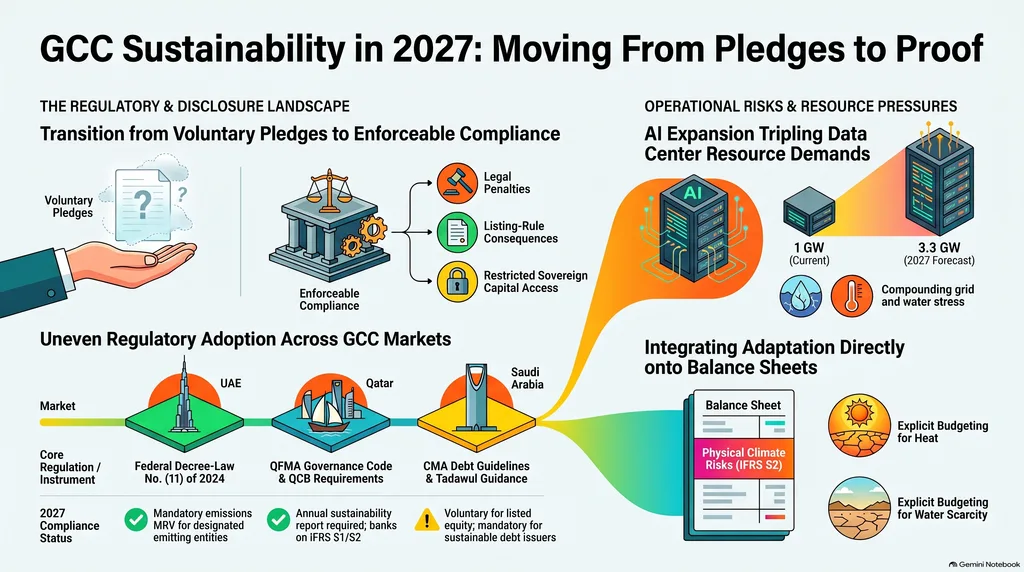
or listen to this short audio review that gives a quick recap of the main ideas:
Alternatively you can watch this short explainer video on YouTube that provides an overview of key topics of the post:
Introduction
For most of the past decade, corporate sustainability in the Gulf was judged by what companies said. Net-zero pledges, glossy reports and conference announcements were the currency. That era is ending. By late 2026, the question boards in Riyadh, Abu Dhabi, Doha and Muscat are being asked has changed from “what is your target?” to “can you prove it?”
Several developments in 2025 and 2026 drove that shift. The UAE’s federal climate law, Federal Decree-Law No. (11) of 2024 on the Reduction of Climate Change Effects, entered into force on 30 May 2025, and the one-year adjustment period for affected entities ran to 30 May 2026. Kuwait, Bahrain and Qatar now have binding sustainability disclosure duties for at least part of their listed markets. Oman has set a dated path to IFRS S1 and S2. Saudi Arabia, the region’s largest economy, still relies on voluntary guidance for listed companies, but its sustainable debt market now carries binding disclosure obligations.
At the same time, the context around sustainability has become harder. The regional conflict in early 2026 disrupted shipping through the Strait of Hormuz and, according to reporting cited by ORF Middle East, interrupted data-centre operations in the UAE and Bahrain. Meanwhile, the Gulf’s AI infrastructure build-out is adding large new loads to grids and desalination systems that were already under summer stress.
The result is a more demanding, and more interesting, agenda for 2027. Sustainability in the GCC is becoming less of a communications function and more of an operating discipline. It now sits at the intersection of four things executives already care about: regulatory compliance, energy and water security, supply-chain resilience, and access to sovereign and international capital.
This article sets out six emerging sustainability trends in the GCC in 2027 that we expect to shape corporate sustainability across the region, and what they mean in practice:
- Disclosure is turning into compliance, but unevenly across the six markets.
- Transition plans are being tied to national visions and sovereign capital.
- Energy security and the energy transition are being managed as one agenda.
- Resilience and geopolitics are reshaping supply-chain sustainability.
- AI is both the most useful sustainability tool and a new source of pressure on power and water.
- Adaptation and water-energy security are moving onto the balance sheet.
A note on method. Where a claim rests on a regulation or a published dataset, we name the source. Where we are interpreting or forecasting, we say so. Several claims that circulate widely about GCC reporting rules do not hold up against the underlying instruments, and we flag those explicitly. Regulations in this region change quickly, so readers should confirm any obligation against the current text before acting on it.
Trend 1: Disclosure is becoming compliance, but not in the same way everywhere
The most visible change in GCC sustainability is regulatory. Voluntary ESG reporting is giving way to binding obligations. However, the common shorthand that “the GCC is moving to mandatory ISSB reporting” hides large differences between markets. Getting those differences right is now a compliance matter, not an academic one.
The UAE: a federal emissions duty for entities, plus listed-company reporting
The UAE has created the region’s clearest compliance test. The official legislation portal lists Federal Decree-Law No. (11) of 2024 as issued on 28 August 2024 and effective from 30 May 2025. Law firms and advisers, including BSA Law, describe it as imposing binding obligations on public and private entities whose activities generate greenhouse-gas emissions, including entities in free zones. The core duties are to measure emissions, maintain an inventory, report through the national monitoring, reporting and verification (MRV) system administered by the Ministry of Climate Change and Environment, and plan reductions.
Two points deserve care. First, adviser summaries do not fully agree on scope. Several describe the law as applying to all emitting entities regardless of size. A reference review by Labeeb, which works from the law text, reads the Article 6 measurement and reporting duty as attaching to sources designated by the Ministry and competent authorities. Companies should confirm their own designation status rather than rely on either summary. Second, BSA Law noted in April 2026 that the MRV system itself was still being developed and that authorities were showing some flexibility. The compliance deadline is real; the operational detail is still settling.
For listed companies, the picture is often overstated. Public joint stock companies on ADX and DFM must disclose sustainability information, and have done so for several years. According to the Labeeb review, that disclosure sits inside the integrated annual report under the federal securities regulator’s governance framework, while both exchanges’ ESG guides describe themselves as voluntary. The same review states that the regulator has operated as the UAE Capital Market Authority since 1 January 2026.
A claim circulating in 2026 holds that UAE-listed companies must align with IFRS S1 and S2 from FY2026. We could not find a primary instrument that supports this. KPMG’s review of ISSB adoption in the UAE describes leading listed entities adopting the standards voluntarily. This should be treated as a market direction, not a current legal requirement.
Saudi Arabia: voluntary for listed equity, binding for sustainable debt
Saudi Arabia remains voluntary for listed-company sustainability reporting. The Saudi Exchange’s 2021 ESG Disclosure Guidelines encourage disclosure but contain no obligation language. Adoption is nonetheless rising: according to a Capital Market Authority release reported by Zawya, 94 listed companies issued sustainability reports in 2024, up from 81 in 2023.
The binding edge is in debt markets. The CMA’s guidelines for green, social, sustainability and sustainability-linked debt instruments impose disclosure obligations on issuers. For companies that plan to fund transition projects through sukuk or bonds, this is already a compliance regime in practice.
The widely repeated claim that TASI 30 companies must report under IFRS S1 and S2 from 2026 is not supported by any instrument we could find. Both Spectreco and the Labeeb review state that Saudi Arabia has no confirmed ISSB deadline for listed companies. A Saudi mandate in 2027 or 2028 is plausible, but that is a forecast, not a fact.
Qatar, Kuwait, Bahrain and Oman: smaller markets, firmer rules
The smaller GCC markets have, in several respects, moved faster than Saudi Arabia. The table summarises the position as reported by the Labeeb review (last checked 22 September 2026), which cites the underlying instruments. Readers should verify each line against the current regulator text.
Table 1: Emerging Sustainability Trends in the GCC in 2027 – Regulatory Changes across the GCC Markets
| Market | Instrument (as reported) | Who is covered | Status for 2027 |
|---|---|---|---|
| UAE | Federal Decree-Law No. (11) of 2024; securities regulator governance framework | Designated emitting entities incl. free zones; listed PJSCs | Emissions MRV in force; listed sustainability disclosure via integrated report |
| Saudi Arabia | Saudi Exchange ESG Disclosure Guidelines (2021); CMA sustainable debt guidelines (2025) | Listed issuers (voluntary); GSS and sustainability-linked debt issuers (binding) | No dated ISSB mandate found |
| Qatar | QFMA Governance Code, Board Decision No. (5) of 2025; QCB requirements | Main-market companies; banks and insurers | Annual sustainability report required; QCB-regulated entities on ISSB from 1 January 2026 |
| Kuwait | CMA Circular No. (04) of 2025 | Premier Market companies | Mandatory from FY2025, disclosed by end of Q2 |
| Bahrain | Bahrain Bourse Listing Rules Rule 5.22; CBB Rulebook ESG module | Mainboard issuers; banks, insurers and investment firms | ESG report within six months of year-end; 31 prescribed KPIs from FY2024 |
| Oman | MSX ESG Disclosure Guideline; FSA Decision E/7/2026 | Listed SAOG companies | 30 metrics mandatory from 2025; IFRS S1 and S2 phased in from 1 January 2029 |
Across all six markets, the common denominator is the GCC Exchanges Committee’s unified set of 29 ESG disclosure metrics. It is voluntary, but it provides a practical baseline for groups that report in several jurisdictions.
What this means for 2027
Three implications stand out.
The first is that data quality now carries legal and financing consequences. Under the UAE law, emissions data feeds a government system and can trigger administrative penalties. In Qatar and Kuwait, missed disclosure is a listing-rule matter. This changes who owns the data. Sustainability teams can no longer run emissions inventories as side projects; finance, operations and internal audit need to be involved, much as they are in financial reporting.
The second is that group reporting does not equal local compliance. Multinationals that report under the EU’s CSRD or the UK’s ISSB-based regime should not assume their group disclosures satisfy UAE domestic obligations. As Zevero notes, the UAE law is an additional, parallel requirement at the entity level.
The third, and this is our analysis rather than an established fact, is that ISSB is becoming the region’s reference language even where it is not yet mandatory. Qatar’s banking regulator and Oman’s FSA have already adopted it with dates. Investors, sovereign funds and international lenders increasingly ask for IFRS S2-style climate information. For most large GCC companies, building reporting systems to IFRS S2 specifications in 2027 is likely to be cheaper than retrofitting them once mandates arrive.
Trend 2: Transition plans are being tied to national visions and sovereign capital
In Europe, corporate transition plans are usually framed around investor expectations and climate science. In the GCC, they are increasingly framed around the state. This is not a cosmetic difference. It shapes what a credible plan looks like, who reads it and what it unlocks.
The national targets set the outer frame. According to ORF Middle East, the UAE and Oman have net-zero targets for 2050, while Saudi Arabia, Kuwait and Bahrain have set 2060. Qatar has no net-zero target; its nationally determined contribution instead commits to a 25% emissions reduction by 2030 against a business-as-usual baseline, as summarised by the Gulf International Forum. Above these sit the long-range economic programmes: Saudi Vision 2030, We the UAE 2031, Qatar National Vision 2030, Oman Vision 2040, Kuwait Vision 2035 and Bahrain Economic Vision 2030.
What has changed is how directly companies are expected to connect their own plans to these frameworks.
Why alignment with the state matters more than in other regions
Three structural features explain the GCC’s state-led model.
The state is often the largest customer, landlord, utility and investor at the same time. Sovereign wealth funds and government-related entities anchor many of the region’s large projects in renewables, hydrogen, industrial decarbonisation and digital infrastructure. A&O Shearman’s GCC energy transition outlook points to flexible legal systems, centralised planning and close public-private engagement as reasons the region can deploy capital quickly.
National priorities extend beyond carbon. Local value creation, workforce nationalisation and industrial localisation sit alongside emissions in national strategies. Regulators are starting to write this into disclosure. According to the Labeeb review, Qatar’s 2025 governance code requires ESG disclosure that names Qatarization alongside carbon emissions, energy, water and waste.
Energy revenues fund the diversification itself. A&O Shearman notes that maintaining oil and gas revenues enables diversification, which in turn pushes national oil companies to supply lower-cost, lower-carbon hydrocarbons. The same analysis estimates that Saudi Arabia’s renewables build-out could reduce domestic oil burn by roughly one million additional barrels per day by 2030, freeing those barrels for export.
What a credible GCC transition plan looks like in 2027
Our view, based on the regulatory trajectory and how sovereign investors are behaving, is that a credible transition plan for a GCC company in 2027 will need to do four things that a generic net-zero roadmap does not.
- Show the link to national priorities explicitly. Name which national targets and programmes the plan supports, whether that is renewable capacity, localisation, a sector strategy or workforce goals.
- Tie targets to capital allocation. IFRS S2 asks for information on transition plans, and the ISSB published guidance on transition plan disclosures in June 2025. Investors will look for capex, not just commitments.
- Be honest about the hydrocarbon base. For energy and petrochemical companies, a plan that ignores the continued role of oil and gas will not be believed. One that shows how production emissions fall while the product mix shifts is more defensible.
- Survive a change in state priorities. Plans built around a single flagship programme are exposed if that programme is resized or delayed. Scenario analysis should include shifts in national investment priorities, not only carbon prices.
The opportunity and the catch
The opportunity is real. Companies that can show measurable local value and a verifiable transition path are better placed for government procurement, sovereign co-investment and sustainable finance. The catch is scrutiny. When transition credibility becomes a condition of access to capital, weak data and overstated claims become commercial risks, not just reputational ones. We expect this tension, between the pull of sovereign alignment and the push of verifiable disclosure, to define the quality gap between leaders and laggards in 2027.
Trend 3: Energy security and the energy transition are becoming one agenda
Outside the Gulf, energy security and decarbonisation are often debated as competing priorities. In the GCC, they are increasingly managed together. A&O Shearman’s 2026 outlook captures this as “security meets transition”: the region aims to remain a dependable exporter of conventional energy while building a comparable role in the energy systems that follow.
What is happening
The evidence points to several parallel moves rather than a single pivot.
National oil companies are cutting the emissions intensity of their own production while expanding into LNG, lower-carbon petrochemicals and carbon capture, according to A&O Shearman. Carbon capture is being planned at industrial scale: AGBI reports that Saudi Arabia’s Jubail Industrial City aims to capture about 44 million tonnes of CO2 a year by 2035, and that Qatar operates a large scheme at Ras Laffan.
Renewables and storage are scaling, but unevenly. ORF Middle East, citing Arab News, reports that clean energy accounted for 32.4% of the UAE’s installed capacity as of September 2026. It contrasts this with Saudi Arabia, where it estimates renewables supply around 4% of power against a 50% generation target for 2030. That Saudi figure comes from a secondary tracker and should be verified against official data before it is relied on. At the other end, ORF Middle East’s earlier analysis put installed renewable capacity in Kuwait and Bahrain at only 114 MW and 69 MW respectively in 2024.
The resource base is also widening. A&O Shearman describes a shift “from barrels to ores”: outbound investment in mines, domestic mining in Saudi Arabia and Oman, new refineries and smelters, green or blue steel projects and early manufacturing of solar and wind components.
Why it matters for companies
For most GCC companies, the practical effect is that energy procurement has become a sustainability decision and a resilience decision at the same time.
A renewable power purchase agreement lowers Scope 2 emissions, but in the GCC it also hedges against future tariff reform and secures supply for energy-intensive operations. Captive solar with battery storage is increasingly attractive for large loads. A Chambers practice guide written by King & Spalding lawyers notes that large data-centre operators are becoming anchor customers for captive solar PV and battery storage across the Middle East.
Export markets add a second driver. A&O Shearman notes that international regulation, including European border taxes and offtake incentives in Japan and Korea, often drives the business case for low-carbon projects in the region. The EU’s Carbon Border Adjustment Mechanism moved into its definitive phase in 2026. For GCC exporters of aluminium, steel, fertilisers and hydrogen, product-level carbon intensity is now a commercial variable, not only a reporting metric.
The challenges
The tensions are real and should not be glossed over.
- Domestic demand keeps rising. Population growth, industrialisation, cooling and now data centres are lifting electricity demand. New renewables often add to supply rather than displace existing gas or oil-fired generation.
- Firm power remains fossil-heavy. ORF Middle East argues that intermittent renewables alone cannot meet round-the-clock data-centre loads without storage or thermal baseload, and that fossil fuels will continue to anchor grid stability in the near term.
- Carbon capture carries delivery risk. Large CCS targets depend on storage capacity, cost and policy support. As the AGBI piece argues, capture without carbon pricing may not be enough to reach national net-zero goals.
- Pricing signals are weak. Subsidised domestic energy blunts the business case for efficiency. Several GCC states have reformed prices before, but further reform is politically sensitive.
What to expect in 2027
Our expectation is that 2027 will bring more corporate renewable procurement, more battery storage paired with solar, and growing attention to product carbon footprints among exporters. A&O Shearman anticipates upward pressure on compliance costs in the short term and a widening renewables roll-out beyond the UAE and Saudi Arabia. The open question is whether carbon pricing arrives. The UAE’s emissions MRV system and ADGM’s carbon trading platform provide some of the infrastructure, but we have not seen a confirmed GCC carbon tax or compliance trading scheme. Any statement that one is imminent should be treated as speculation.
Trend 4: Resilience and geopolitics are reshaping supply-chain sustainability
For years, supply-chain sustainability in the Gulf meant two things: supplier codes of conduct and, for the more advanced companies, Scope 3 estimates. Events in 2026 have added a third dimension that now competes for the same management attention: geopolitical exposure.
What changed in 2026
The regional conflict that began in early 2026 made the abstract concrete. ORF Middle East’s October 2026 analysis of data-centre resilience in the Gulf cites reporting that disruption around the Strait of Hormuz affected the circuit-board supply chain and raised costs for technology firms. It also cites reporting of drone-related outages at data centres in the UAE and Bahrain in March 2026, and of a steep rise in cyberattack attempts.
These events sit on top of longer-running concentration risks. ORF Middle East notes that China accounts for around 60–70% of rare-earth mining and nearly 90% of processing capacity, and that the most advanced chips and lithography equipment come from a handful of suppliers. For a region building AI infrastructure, renewables and new industries at speed, these dependencies are not remote.
The global evidence points the same way. The World Economic Forum’s inaugural Chief Sustainability Officers’ Outlook, published in September 2026 and based on a survey of 103 sustainability leaders, found that geopolitical fragmentation is a significant drag on the transition. Yet 63% of respondents still expect progress to hold steady or accelerate over the next 12 months.
How GCC governments are responding
Governments are responding with localisation and diplomacy. ORF Middle East reports that Saudi Arabia has increased local manufacturing of high-voltage switchgear and cooling equipment, and that the UAE has established an AED 1 billion National Industrial Resilience Fund to support localisation of advanced technologies. The UAE’s Comprehensive Economic Partnership Agreements, and GCC-level trade agreements in progress, aim to broaden supplier access.
For companies, this creates both a requirement and an opening. Localisation policies reward suppliers that can manufacture in-country. They also shift where emissions, water use and labour risks sit in the value chain.
What this means for corporate sustainability teams
Our view is that resilience and sustainability due diligence will converge in 2027. Running them as separate exercises duplicates work and misses the links between them. A supplier in a water-stressed location, dependent on a single shipping route and exposed to export controls, is a sustainability risk, a continuity risk and a compliance risk at once.
In practice, that means extending the supplier assessment many GCC companies already run for ESG purposes to cover:
- Concentration: single-source and single-country dependencies for critical inputs, particularly electrical equipment, semiconductors and battery materials.
- Route exposure: reliance on specific straits, ports and shipping lanes, with tested alternatives.
- Policy exposure: export controls, tariffs and sanctions that could interrupt supply or change costs at short notice.
- Physical climate risk: heat, water stress and flooding at key supplier sites.
- Emissions and social data: the Scope 3 and human-rights information that disclosure regimes and international customers will increasingly ask for.
Challenges and trade-offs
This is harder than it sounds. Supplier data in the region is often thin, and many smaller suppliers have no emissions inventory at all. Localisation can raise costs in the short term and may increase emissions where local production is more carbon-intensive than imports. Resilience also costs money: holding strategic stock of long-lead items such as transformers and switchgear, which ORF Middle East recommends at the GCC level, ties up capital.
The companies that handle this well will be those that treat resilience spending as an investment with a measurable return, avoided disruption, rather than as an overhead. The WEF survey suggests that is where many sustainability leaders already see the business case moving.
Trend 5: AI is both the sustainability team’s best tool and a new source of pressure
No region illustrates the double edge of artificial intelligence for sustainability more clearly than the Gulf. The same governments that see AI as a pillar of economic diversification are building data centres in one of the world’s hottest, most water-stressed environments.
The enabler
On the corporate side, AI and better data platforms are making sustainability work more feasible. The practical gains are in areas that have long been bottlenecks for GCC companies: collecting activity data from many sites, estimating Scope 3 emissions from procurement records, mapping supplier networks, running climate scenarios and preparing assurance-ready audit trails. The WEF’s CSO Outlook found that sustainability leaders see AI offering new execution capabilities, while flagging resource trade-offs alongside them.
This matters in the GCC because reporting obligations are arriving faster than reporting teams are growing. In our assessment, companies that automate data collection and controls in 2027 will find the UAE MRV cycle and ISSB-style disclosure far less costly than those that rely on annual spreadsheet exercises. That is an informed judgement rather than a measured finding.
The pressure point
The infrastructure side is where the tension lies. PwC Middle East projects regional data-centre capacity to roughly triple, from 1 GW in 2025 to 3.3 GW within five years. Individual announcements are larger still. ORF Middle East lists G42’s Stargate UAE campus at 5 GW at full build-out by 2030, which it calculates at about 11.4% of the UAE’s installed grid capacity, and Saudi Arabia’s HUMAIN platform at 1.9 GW by 2030.
The gap between those numbers is itself informative. A single announced UAE campus exceeds PwC’s projection for the whole region. Forecasts differ in scope and methodology, and announced capacity is not delivered capacity. Readers should treat all of these figures as indicative ranges, and expect revisions as projects move from announcement to construction.
Whatever the final number, the resource implications are significant:
- Power. ORF Middle East notes that mid- to large-sized AI facilities can consume as much electricity as up to two million households, citing IEA analysis. Round-the-clock loads favour firm generation, which in the GCC still largely means gas.
- Water. The same analysis cites estimates that such facilities can use up to five million gallons of water a day where evaporative cooling is used.
- The co-generation trap. Much of the region’s power and desalinated water is produced together. ORF Middle East explains that this coupling makes it hard to manage water supply independently of electricity demand, producing summer surpluses and potential winter shortfalls.
- Physical and cyber risk. As noted under Trend 4, data centres in the region have already been affected by conflict-related disruption.
Where the solutions are
The technical options are known. ORF Middle East reports that closed-loop liquid cooling can cut direct water consumption by up to 98%, and that treated sewage effluent offers the most scalable alternative to potable water for cooling. Captive solar with battery storage, grid interconnection through the GCC Interconnection Authority and, in the UAE, interest in small modular reactors are all being discussed for power supply.
What it means for companies
For data-centre developers and operators, water and power strategy will be a licence-to-operate question in 2027. Expect permitting, offtake agreements and investor due diligence to probe cooling technology, water sources and the carbon intensity of supply.
For every other company, AI governance now has a sustainability dimension. Three questions are worth asking before scaling AI use: where the compute runs and on what energy mix; how that consumption appears in Scope 2 and Scope 3 accounting; and whether data-sovereignty and security requirements constrain the choice of provider. The answer will rarely be to avoid AI. It will usually be to use it deliberately and account for it honestly.
Trend 6: Adaptation and water-energy security are moving onto the balance sheet
Gulf sustainability strategies have historically focused on mitigation: cutting emissions, adding renewables, setting net-zero dates. Adaptation, preparing assets and operations for the climate that is already arriving, has been treated as a government responsibility. That division is becoming harder to sustain.
The physical reality
ORF Middle East notes that the region is warming at around three times the global average, citing peer-reviewed research. Summer cooling demand already strains grids. The April 2024 floods in the UAE and Oman showed that rare but severe rainfall events can disrupt operations in a region whose infrastructure was not designed for them. Water remains structurally scarce, with heavy reliance on energy-intensive desalination.
Governments are investing heavily in response. ORF Middle East, citing an August 2026 report in The National, notes that Gulf states are directing billions into water security, largely through new desalination, to support AI and industrial ambitions. ORF Middle East cautions that expanding desalination without parallel demand-side efficiency is costly and environmentally damaging, given its energy intensity and effects on marine ecosystems.
Why it is becoming a corporate issue
Three forces are pushing adaptation from public policy into corporate planning.
Disclosure is one. IFRS S2 requires companies to disclose material physical climate risks and how they are being managed. As ISSB-aligned reporting spreads across the GCC, physical-risk assessments will become a standard part of the annual cycle for listed companies and banks.
Capital is another. Lenders and insurers price physical risk into long-lived assets. The WEF CSO Outlook found that adaptation is becoming a core question of resilience and capital allocation, and that companies already managing resilience proactively are seeing those investments pay off.
Operations is the third. For energy-intensive and water-intensive businesses, such as industrial plants, data centres, hospitality, agriculture and real estate, heat and water stress affect output, labour productivity and asset life directly.
What good practice looks like
Our recommendation is that GCC companies treat energy and water as one planning problem rather than two. In practice, that involves several steps:
- Mapping physical climate risk at site level, including extreme heat, flash flooding and coastal exposure.
- Securing water supply through reuse, treated sewage effluent and on-site recycling, rather than relying solely on municipal desalinated supply.
- Pairing renewable procurement with storage to reduce exposure to grid stress during summer peaks.
- Building heat-stress protocols for outdoor workers into health and safety systems, which also strengthens the social side of ESG disclosure.
- Including adaptation capex explicitly in transition plans, rather than presenting decarbonisation alone.
The outlook
We expect adaptation to feature more prominently in GCC sustainability disclosures in 2027, driven mainly by IFRS S2 adoption in the financial sector and growing lender scrutiny. The main obstacle is data: downscaled climate projections for specific Gulf sites are still limited, and many companies lack the in-house expertise to translate them into financial terms. That gap is also an opportunity for advisers, insurers and technology providers who can close it.
What could slow the shift
The trends above describe a direction, not a certainty. Several forces could slow or redirect them in 2027, and executives should plan for them rather than assume a smooth path.
- Regulatory fragmentation. Six markets have six different instruments, timelines and metric sets. Saudi Arabia, the largest economy, has no listed-company mandate. The UAE’s MRV system is still maturing, and advisers disagree on its scope. Groups operating across the region face duplicated effort and the risk of misreading obligations. Some convergence around ISSB and the GCC unified metrics is likely, but its pace is uncertain.
- Capability and assurance gaps. Measuring emissions credibly requires metering, data systems, trained staff and independent verification. In the GCC, demand for all four is rising faster than supply. First-cycle data under the UAE law is likely to be uneven in quality. That is normal for a new regime, but it limits how far regulators and investors can rely on it in the short term.
- Uncertain economics. The WEF CSO Outlook, as reported by WAM, found that 62% of surveyed sustainability leaders cited uncertain cost-benefit assessments as the main barrier to investment. In the GCC, subsidised domestic energy and water prices make that calculation harder still, because the savings from efficiency are partly hidden.
- Geopolitical shocks. The 2026 regional conflict showed how quickly security concerns can absorb management attention and capital. A prolonged or renewed disruption could delay discretionary sustainability investment, even as it strengthens the case for resilience spending.
- Credibility risk. The more sustainability is tied to sovereign priorities and access to capital, the greater the temptation to overstate. Announced capacity, whether in renewables, hydrogen, carbon capture or data centres, often runs well ahead of what is delivered. Investors and regulators are becoming more alert to this gap, and companies whose claims outrun their data are exposed.
- Mixed global signals. Outside the region, the direction of sustainability regulation has not been uniform, with debates in several jurisdictions about simplifying or delaying reporting rules. GCC regulators may watch those debates closely. However, the regional drivers described in this article, from water scarcity to sovereign investment strategy, do not depend on what happens in Brussels or Washington.
None of these obstacles reverses the overall trend. Taken together, they suggest that progress in 2027 will be uneven across countries, sectors and companies, and that the gap between well-prepared and poorly prepared organisations is likely to widen.
A practical roadmap for GCC executives in 2027
The six trends point to one conclusion: sustainability performance in the GCC will increasingly be judged on evidence. The roadmap below is our recommendation for how a large company operating in the region can prepare over the next 12 to 18 months. It assumes a listed or sizeable private group with operations in at least one GCC market; smaller companies can scale it down.
Next 90 days: establish what applies and who owns it
- Map obligations by entity and market. List every legal entity in the GCC and identify which instruments apply: the UAE climate law and its designation status, exchange rules in each listing market, banking or insurance regulator requirements, and sustainable debt covenants. Confirm each against the current regulator text, not secondary summaries.
- Assign accountable owners. Make one executive accountable for emissions data, with clear roles for finance, operations, procurement and internal audit. Treat emissions reporting as a controlled process, like financial reporting.
- Brief the board. Give directors a short, factual view of regulatory exposure, data readiness and the main physical and supply-chain risks. Boards cannot oversee what they have not been shown.
By mid-2027: build compliance-grade data and a credible plan
- Make Scope 1 and 2 data assurance-ready. Document methodologies, emission factors, data sources and controls. Plan for limited assurance even where it is not yet required.
- Start on Scope 3 where it matters. Focus on the two or three categories that dominate your footprint and that customers or lenders ask about, rather than attempting full coverage at once.
- Build reporting to IFRS S2 specifications. Even in markets without an ISSB mandate, structuring governance, strategy, risk management and metrics this way reduces future rework.
- Rewrite the transition plan around capital. Link targets to budgeted projects, connect them explicitly to national priorities and local value creation, and include adaptation spending.
By end-2027: integrate resilience and use technology deliberately
- Merge resilience and sustainability due diligence. Extend supplier assessments to cover concentration, route and policy exposure, physical climate risk and emissions data in one process.
- Secure energy and water inputs. Evaluate renewable procurement with storage, water reuse and cooling efficiency for major sites, especially digital infrastructure.
- Automate data collection and controls. Use AI and data platforms for activity data, supplier mapping and scenario analysis, and account for the energy, water and data-sovereignty implications of the AI itself.
- Test the plan against shocks. Run scenarios that include supply disruption, energy price reform, a Saudi or UAE disclosure mandate arriving earlier than expected, and a shift in national investment priorities.
A test for every claim
One discipline is worth applying throughout. Before any sustainability statement is published, ask whether it could survive scrutiny from a regulator, an auditor and a sceptical investor. If the honest answer is no, the claim needs better evidence or more careful wording. In a market where disclosure is becoming law, that test is no longer optional.
Free Download
Would you like to have all the important points in a professional PDF slide deck? Click on the button below to download your free PDF:
Conclusion: from pledges to proof
The World Economic Forum’s Sebastian Buckup summarised the global mood in September 2026: the transition is “no longer a question of ambition, it’s a question of execution.” In the GCC, that shift has an extra layer. Execution here means delivering on national visions, operating reliably in an arid and heating climate, and staying resilient through geopolitical shocks, all while meeting disclosure rules that differ from one market to the next.
The companies best placed for 2027 will not be those with the boldest targets. They will be those that can show, with data that withstands scrutiny, that their transition plan is funded, that their energy and water inputs are secure, that their supply chains can absorb disruption, and that their operations create local economic value. That is a higher bar than the region has faced before. It is also a clearer one.
Sources
- UAE Legislation portal, Federal Decree-Law No. (11) of 2024 on the Reduction of Climate Change Effects (issue and effective dates; article text not displayed on the page)
- Labeeb, GCC Sustainability Reporting: What Is Actually Mandatory, last checked 22 September 2026 (secondary review citing the primary instruments; used for the country table)
- ORF Middle East, Data Centre Resilience in the Gulf, 7 October 2026
- A&O Shearman, The GCC energy transition 2026: energy security meets energy transition in a fragmented world, 26 February 2026
- PwC Middle East, Unlocking the data centre opportunity in the Middle East, April 2025
- World Economic Forum, Chief Sustainability Officers’ Outlook press release, 15 September 2026
- WAM, 63% of chief sustainability officers expect faster progress, 16 September 2026
- KPMG UAE, Adoption of the ISSB Standards
- BSA Law, UAE Climate Law: What Every Business Needs to Know Before May 2026, April 2026
- Zevero, UAE Climate Law
- Zawya (CMA press release), Saudi Arabia issues Green, Social, and Sustainable Debt Instruments Guidelines
- Spectreco, Saudi Arabia ISSB Reporting: What Tadawul Companies Must Do
- ORF Middle East, Energy Transitions in the Gulf: Realities, Risks and the Road Ahead
- Gulf International Forum, The Race to Net Zero: Saudi Arabia and the UAE
- AGBI, The Gulf needs carbon taxes, not just capture, to reach net zero, May 2026
- Chambers Global Practice Guides (King & Spalding), Power Generation, Transmission and Distribution 2026: Middle East
- S&P Global Sustainable1, Where does the world stand on ISSB adoption?, June 2025
- The National, Gulf pours billions into water security, 22 August 2026